Have you ever seen a green certification logo on a company website and wondered what it actually means for day‑to‑day operations? ISO 14001 is the world’s leading standard for Environmental Management Systems (EMS), used by more than 150,000 organisations globally and roughly 5,700 certified organisations in Australia alone as of 2023.
Industry research shows that organisations using ISO 14001 typically see measurable improvements in energy and water efficiency, waste reduction, and regulatory compliance. For professionals, ISO 14001 training is less about learning dense bureaucracy and more about mastering a structured “Global Recipe Book” for sustainability that turns vague green goals into clear, repeatable routines.
Organisations that adopt ISO 14001 do so because it delivers both environmental and financial benefits. Surveys and implementation studies indicate that EMS‑certified companies commonly report:
- Lower energy and resource consumption, with documented reductions in electricity, water, and raw‑material use.
- Improved technical efficiency by around 2–3%, which can translate into millions of dollars in additional sales or cost savings for mid‑ to large‑sized firms.
- Stronger compliance posture, reducing the risk of regulatory fines and helping them win tenders and contracts that require environmental proof points.
In Australia, ISO 14001 adoption has surged among SMEs in construction, engineering, and manufacturing, where governments and large contractors increasingly expect certified environmental management systems. For you, this means that ISO 14001 skills are not a niche compliance add‑on but a core business‑enabling capability.
Pursuing an ISO 14001 auditor credential is a bit like choosing between being a home inspector checking your own house or serving as a professional inspector for other homes. The two most common routes are internal auditor and lead auditor:
ISO 14001 Internal Auditor (In‑House Role)
- Many providers run ISO 14001 internal auditor training as a 2‑day, roughly 16‑hour course, focused on planning, conducting, and reporting internal EMS audits.
- Internal auditors typically work inside their own organisation, identifying opportunities such as reduced paper use, better waste segregation, or energy‑saving behaviour.
Career‑wise, internal‑auditor‑level skills are increasingly valued in roles like sustainability coordinator, EHS officer, and EMS implementer, where employees drive continuous improvement rather than just “tick‑box” audits.
- A recognised ISO 14001 lead auditor course is typically a 5‑day, 40‑hour program, aligned with international auditor‑body schemes such as CQI/IRCA and ISO 19011.
- Lead auditors are responsible for leading audit teams, planning full‑scope EMS audits, and reporting to certification bodies, clients, or senior management.
- Many professionals use this credential to move into roles such as environmental auditor, sustainability consultant, compliance manager, or quality and compliance director.
Salary data from Australia indicates that ISO lead auditors can earn around AUD 85,000 on average, with experienced professionals often reaching AUD 90,000–110,000+. Even for internal‑auditor‑level roles, additional certifications such as ISO internal auditor often correlate with mid‑six‑figure earning ranges when combined with experience and multi‑standard expertise.
Most professionals start with internal‑auditor‑level training to build in‑house credibility before advancing to the lead‑auditor level, which opens doors to consulting and higher‑impact roles.
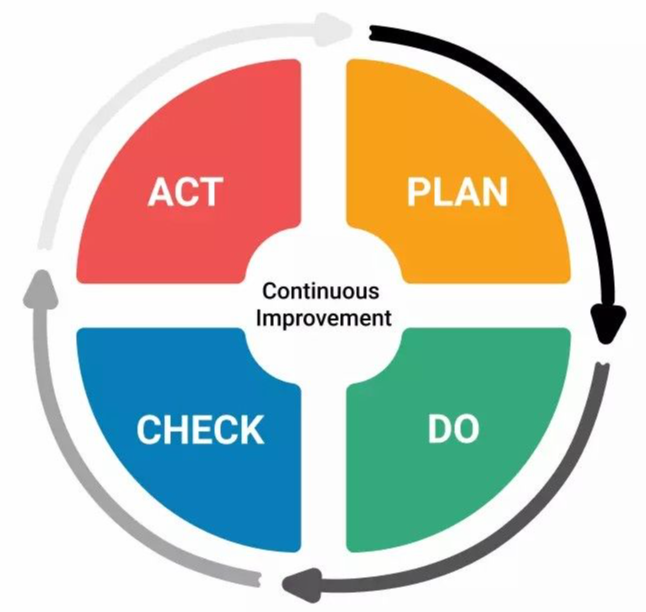
The core engine of ISO 14001 is the Plan‑Do‑Check‑Act (PDCA) cycle, a continuous improvement framework used across quality, safety, and environmental management systems. You can think of it as a feedback loop that turns guesswork into measurable progress.
Imagine a high electricity bill at home. You wouldn’t just hope next month is cheaper. Instead:
- Plan: You set a target (e.g., reduce home electricity use by 15% in 3 months) and decide on actions such as switching off idle electronics and replacing old bulbs.
- Do: You implement those actions consistently.
- Check: You compare your next bill against the previous one and analyse the change.
- Act: If savings are small, you upgrade to a more aggressive action (e.g., installing a smart thermostat or solar‑compatible lighting).
In an organisation, PDCA works the same way but at scale. For example:
- A construction firm might plan to cut site‑waste disposal by 25%, then standardise material handling, monitor skip‑weight data, and refine storage and cutting practices.
- A manufacturing plant might plan to reduce process‑water use, then measure flow‑meter data, check performance weekly, and act by retrofitting high‑efficiency nozzles.
By framing ISO 14001 through PDCA, you stop treating sustainability as a one‑off project and start treating it as a repeatable improvement engine that can be applied to almost any process.
Logging into an ISO 14001 online course should feel like entering a structured learning hub, not decoding a legal contract. Most reputable providers break the standard into digestible modules that mirror the structure of ISO 14001:2015 itself.
A typical foundational or internal‑auditor‑style ISO 14001 course will cover:
- Understanding environmental aspects and impacts – learning how activities, products, and services interact with the environment and how to rank significant impacts.
- Mapping environmental legal requirements – introducing how to identify and track relevant environmental laws, permits, and industry codes without becoming a compliance lawyer.
- Developing an environmental policy – showing how to draft a concise, leadership‑owned policy that aligns with ISO 14001 clauses and the organisation’s strategy.
- Planning objectives and targets – turning “we want to be greener” into specific, measurable goals (e.g., “reduce printing costs by 20% in 12 months” or “cut warehouse energy use by 10%”).
- Preparing for internal audits – teaching how to design checklists, conduct interviews, and document evidence in line with ISO 19011 principles.
Many modern ISO 14001 courses are delivered online with self‑paced modules, scenario‑based questions, and practical case studies. While some assessments are open‑book or scenario‑driven, the emphasis is on applied thinking, not rote memorisation.
Once you finish an ISO 14001 course, the natural next step is to run or support your first internal EMS review. ISO‑aligned training teaches auditors to follow an evidence‑based, non‑punitive approach—more like a health‑check coach than a strict inspector.
Step 1: Review the Paperwork
- Check that environmental policies, objectives, and procedures align with ISO 14001 clauses such as leadership, planning, and operational control.
- Verify that records for energy use, waste, emissions, and incidents match what the organisation claims (e.g., monthly utility bills, chemical‑use sheets, and spill‑logs).
Step 2: Observe the Work
- Walk the site, office, or warehouse and observe how people actually behave compared to procedure documents.
- Are recycling bins clearly labelled and used correctly?
- Are lights and equipment switched off outside working hours?
- Are spill‑response kits accessible and stocked?
Step 3: Talk to the Team
- Ask staff in their own words what they know about environmental requirements and how they contribute to saving resources.
- Use simple, non‑threatening questions such as “What do you do when you see a spill?” or “How do you know which waste goes where?”
This trio of documents, observation, and conversation is the backbone of ISO 14001‑aligned auditing. Well‑run internal reviews don’t just generate a report—they uncover hidden efficiency gains and build staff awareness of how everyday actions tie into broader environmental goals.
You don’t need years to become a credible environmental professional; you can build a realistic 30‑day roadmap that aligns with how many ISO 14001 training providers and employers think about competency development.
Days 1–5: Foundational ISO 14001 Training
- Enrol in an introductory or internal‑auditor‑level ISO 14001 course. Many online options can be completed in 2–5 days of self‑paced learning.
- Focus on understanding:
- Key ISO 14001 clauses (leadership, planning, support, operations, performance evaluation, improvement).
- The difference between environmental aspects (causes) and impacts (effects).
Days 6–15: Apply Learning In‑House
- Pick one small process (e.g., office printing, warehouse energy use, or on‑site waste) and apply PDCA to it:
- Define one measurable objective (e.g., cut paper use by 20% in a quarter).
- Document current practices and baseline data.
- Prepare a mini‑audit checklist aligned with ISO 14001 requirements and practice interviewing colleagues.
Days 16–30: Run a Pilot Internal Review
- Conduct a pilot internal audit on that process, gathering evidence, writing brief findings, and suggesting simple corrective actions.
- Present your results to a manager or EHS contact, framing them as cost‑saving and risk‑reduction opportunities, not just compliance items.
By day 30, you position yourself as someone who can:
- Speak the language of ISO 14001.
- Run basic internal EMS reviews.
- Show how sustainability choices translate into tangible business outcomes.
Demand for “green skills” is rising faster than supply. Global data shows that demand for green talent grew more than twice as fast as supply between 2023 and 2024, with projections that one in five jobs by 2030 will lack qualified green‑skills holders.
In Australia, industries such as construction, manufacturing, energy, and infrastructure increasingly look for candidates who can:
- Implement or maintain an ISO 14001‑style EMS.
- Link environmental data to business performance.
- Support tenders and regulatory‑compliance requirements.
Whether you’re aiming for roles such as sustainability manager, EHS coordinator, internal auditor, or lead‑auditor‑level consultant, ISO 14001 training gives you a concrete, quantifiable way to stand out in a competitive market.
Empty space, drag to resize