Two certifications now define the sustainable finance credential landscape: the CFA Institute's Sustainable Investing Certificate (commonly called the CFA ESG exam) and GARP's Sustainability and Climate Risk (SCR) Certificate. Both are growing rapidly - CFA ESG has surpassed 74,000 global registrations since its 2019 launch, while GARP SCR has exceeded 16,000 registered candidates and 7,000 certificate holders.
But these are not interchangeable qualifications. They differ in scope, difficulty, pass rates, exam formats, and ideal candidate profiles. This guide cuts through the noise with the most current data available -updated pass rate figures, recent exam format changes, and practitioner insights from candidates who have sat both exams.
The CFA Institute does not publicly disclose the pass rate for its Sustainable Investing Certificate (formerly Certificate in ESG Investing). This creates a vacuum that third-party prep providers fill with estimates - and those estimates vary more than candidates expect.
The most commonly cited figure is around 81%, which appears to reflect the pass rate from the exam's early editions under CFA UK. However, more recent data tells a different story. Analysis suggests the pass rate dropped to approximately 71.8% from late 2022 onwards - a meaningful decline from the earlier cohort figure of around 81%. Other sources, including Kaplan Schweser, place the historical range at 70-80%.
What explains the variation? Several factors are at play: the candidate pool has broadened significantly beyond traditional finance professionals, the curriculum has been updated annually since 2022, and the 2023 edition marked a shift to a calendar-year cycle that altered exam-window dynamics.
Key Takeaway: CFA ESG Pass Rate: The most reliable current estimate for the CFA ESG pass rate is 70-80%, with evidence of a post-2022 decline toward the lower end of that range. The CFA Institute recommends treating this as a rigorous exam requiring genuine preparation, not a tick-box exercise.
The CFA Institute has confirmed it does not disclose the minimum passing score. Based on Edition 1 data and expert analysis, the pass mark is believed to sit between 60% and 70%, with some practitioners estimating it closer to 71-74%. Candidates are advised to target a consistent 75%+ in mock exams to provide a comfortable buffer.
Roughly 25% of exam questions test quantitative knowledge - a figure that surprises many candidates who approach the exam expecting a purely conceptual paper. Governance factors and ESG integration are consistently cited by alumni as the most challenging topic areas, with surveys showing 33% of candidates found the exam harder than expected.
Unlike the CFA ESG exam, GARP publishes pass rate data for each exam window and the results reveal significant session-to-session variation that candidates must understand before planning their preparation timeline.
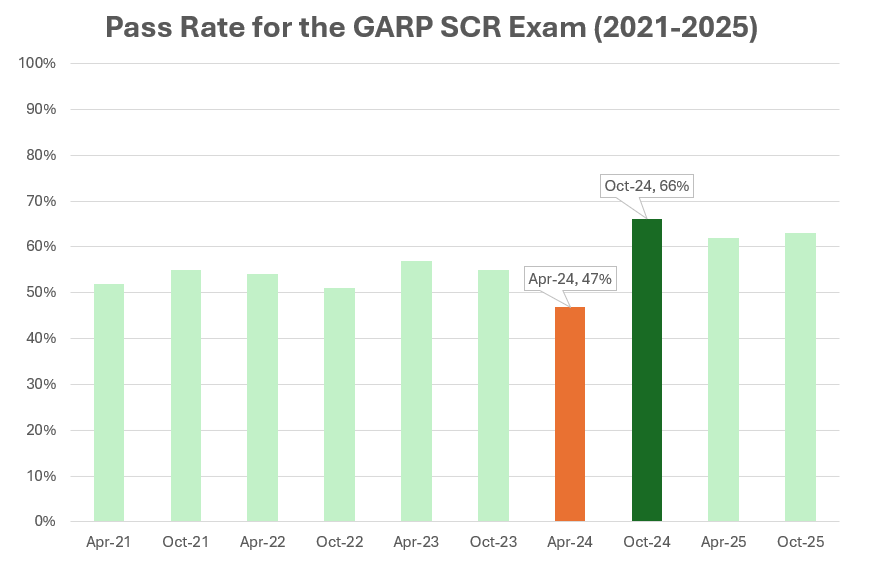
The April 2024 SCR exam recorded a pass rate of just 47% - the lowest in the program's history. The October 2024 session saw a significant recovery, with the pass rate rising to 66%. Historically, pass rates have ranged from 47% to 66%, with the April 2024 session marking the lowest to date.
Candidate feedback from the April 2024 session pointed to a disconnect between official practice materials and actual exam question style, with many describing the questions as heavily memory-focused rather than application-based.
Key Takeaway: GARP SCR Pass Rate: The SCR pass rate is significantly more volatile than the CFA ESG exam, ranging from 47% to 66% across recent sessions. Candidates should prepare for the harder end of the spectrum. The April 2024 cohort provided a clear warning: strong conceptual understanding is not enough if candidates cannot apply knowledge under exam conditions.
Figure showing the pass rate for the GARP SCR Exam 2021-2025, %
The CFA Sustainable Investing Certificate exam consists of 100 single-selection multiple-choice questions, each with three answer choices. Candidates have 2 hours and 20 minutes to complete the exam.
The exam can be taken year-round, either online via remote proctoring or in person at a test centre. Candidates have a 6-month window from registration to sit the exam. A maximum of two attempts is permitted per 6-month period. The curriculum is updated annually on 1 January, so it is critical to confirm which edition applies to your registration date.
Topic weights are not published in granular detail. However, chapters on ESG Analysis, Valuation and Integration and ESG Integrated Portfolio Construction and Management are widely regarded as the heaviest-tested and most challenging, followed by the chapter on governance factors.
The GARP SCR exam underwent a format update from October 2024. The current structure consists of 80 equally-weighted multiple-choice questions, including one multi-part question case study. Candidates are allotted a maximum of four hours to complete the exam.
A significant update for 2025 onwards: GARP introduced online proctoring via Pearson VUE's OnVUE platform starting October 2025, meaning candidates can now sit the SCR remotely - a major accessibility improvement for international candidates.
The 2026 SCR curriculum was updated as of December 2025, with revisions to chapter weightings and the addition of explicit calculation expectations - particularly around carbon metrics. The 2026 edition places increased emphasis on nature-related financial risks and transition planning compared to prior editions.
Crucially, the SCR exam also includes mandatory online readings from external sources - including the UNEP FI Principles for Responsible Banking and UNPRI Principles for Responsible Investment - and these are explicitly examinable, not supplementary. Skipping them is one of the most common and costly preparation mistakes.
The CFA ESG curriculum takes a broad view of the entire ESG investing landscape across nine chapters:
- The ESG market - history of responsible investing, market participants, and the evolution of regulation
- Environmental factors - climate, biodiversity, water, waste, and natural resource risks
- Social factors - labour practices, supply chain standards, community relations, data privacy
- Governance factors - board structure, executive pay, shareholder rights, anti-corruption (often cited as most challenging)
- Engagement and stewardship - how investors engage with companies on ESG issues
- ESG analysis, valuation and integration - quantitative and qualitative approaches to embedding ESG in financial models (highest exam weight)
- ESG integrated portfolio construction and management - applying company-level ESG analysis at the portfolio level (highest exam weight)
- Investment mandates, portfolio analytics and client reporting - how institutional clients specify and monitor ESG mandates
The 2026 SCR curriculum spans 10 chapters covering the full terrain of climate risk practice:
- Foundations of climate change - physical science underpinning the climate crisis
- Sustainability frameworks and ESG principles - global frameworks including TCFD, GRI, SASB
- Climate-related financial risks - physical risk vs transition risk measurement methodologies
- Green and sustainable finance instruments - green bonds, sustainability-linked loans, carbon markets
- Climate risk measurement and scenario analysis - NGFS scenarios, stress testing approaches
- Climate risk at financial institutions - embedding climate risk into enterprise risk management
- Governance and regulatory frameworks - regulatory expectations from Basel, ECB, PRA and others
- Nature-related risks - expanded coverage of TNFD and biodiversity risk (new emphasis in 2026)
- Transition planning - net-zero pathways, Science Based Targets, Paris alignment (new emphasis in 2026)
- Disclosures and reporting - ISSB standards, CSRD, mandatory climate disclosure regimes
The answer depends on your role, career trajectory, and what gap you are trying to fill.
- You work in portfolio management, investment analysis, financial advisory, or wealth management
- Your primary goal is to speak credibly about ESG integration in investment decision-making
- You want year-round exam flexibility and a faster path to certification
- You are building an investment career and want a credential with strong institutional recognition - the Sustainable Investing Certificate is recognised by the UN PRI and backed by over 75 years of CFA Institute credibility
- You want to demonstrate ESG competency without committing to the depth of technical climate risk content
- You work in risk management, compliance, corporate governance, or sustainability strategy
- You need deep technical fluency in climate risk - physical risk, transition risk, scenario analysis, TCFD, ISSB
- Your organisation or clients operate in regulated financial services where climate risk frameworks are mandated (ECB, PRA, MAS)
- You already hold or are pursuing the GARP FRM and want a complementary climate risk credential
- Your role extends beyond finance - SCR is explicitly designed for professionals in supply chain management, operations, and technology dealing with climate impacts
Yes - and for senior practitioners in ESG regulatory strategy or climate risk advisory, holding both credentials is increasingly valuable. The CFA ESG exam provides the investment-side vocabulary; the GARP SCR provides the technical risk management depth. Together, they signal both breadth and depth to employers and clients, and represent a genuinely differentiated credential combination in a market where many candidates hold only one.
Both examining bodies publish recommended study hour ranges, but these are minimum benchmarks for candidates with prior relevant experience.
- CFA ESG: CFA Institute recommends around 130 hours for non-investment professionals and 100 hours for investment professionals. Actual preparation time varies based on English proficiency, existing ESG exposure, and study quality vs quantity.
- GARP SCR: GARP recommends an estimated 100-150 hours of preparation time. Given the April 2024 pass rate shock, many experienced candidates are now budgeting closer to 150-180 hours, particularly for quantitative scenario analysis and carbon metrics content.
1. Take the Mock Exam Early, Not Just at the End
Both exams provide official practice exams. Most candidates save these for the final weeks - a mistake. Taking a mock exam in the first third of your preparation reveals weak points while you still have time to address them systematically. For the GARP SCR in particular, the style of questions has caught candidates off-guard; familiarising yourself early prevents last-minute surprises.
2. Active Retrieval Over Passive Reading
The most common reason candidates fail is passive study - reading notes, highlighting, re-reading. Active retrieval (closing the book and testing yourself) produces significantly better retention. Build retrieval practice into every study session from week one.
3. For the GARP SCR: Do Not Skip the Online Readings
The SCR curriculum includes mandatory online readings from bodies including UNEP FI and UNPRI. These are not supplementary - they are explicitly tested. Candidates who focus only on the official textbook chapters consistently underperform on these questions.
4. For the CFA ESG: Prioritise Chapters 7 and 8
ESG Analysis, Valuation and Integration and ESG Integrated Portfolio Construction and Management carry the heaviest question weighting and are the most technically demanding. Chapters 3, 7, and 8 are the densest, most important, and most challenging - with chapter 7 highlighted as the most relevant for the exam. If time-constrained, these chapters deserve disproportionate attention.
5. Simulate Real Exam Conditions
Take your practice exam under full timed conditions - four hours for the SCR, no interruptions - and treat every wrong answer as a direct study instruction. Return to the specific learning objective for each incorrect response, not just the chapter. The same principle applies to the CFA ESG mock: 100 questions in under 90 seconds each is a pacing challenge as much as a knowledge challenge.
Both certifications carry genuine market value - but in different contexts. The CFA Sustainable Investing Certificate leverages the global recognition of CFA Institute to unlock international career opportunities in ESG investing, and its UN PRI recognition makes it especially powerful for investment professionals at PRI signatory firms.
The GARP SCR is increasingly referenced in regulatory contexts. The European Central Bank, the Bank of England's Prudential Regulation Authority, and the Monetary Authority of Singapore have all published guidance requiring banks to develop climate risk capabilities - and SCR-certified professionals are well-positioned to lead that work. For professionals targeting in-house roles in financial risk, regulatory affairs, or sustainability strategy at financial institutions, the SCR provides more targeted signalling.
SCR-certified professionals are at the forefront of the transition to a more sustainable and climate-resilient global economy, driving innovation, influencing organisational strategy, and contributing to industry standards across financial and non-financial sectors alike.
Job titles commonly held by certificate holders include: ESG Analyst, Sustainability Officer, Climate Risk Manager, ESG Integration Specialist, Responsible Investment Associate, Chief Sustainability Officer, and Risk and Compliance Manager.
- Registration: Open year-round via the CFA Institute website
- Exam window: Candidates have six months to study the curriculum and complete the exam after registering
- Exam delivery: Online (remote proctoring) or in-person at selected test centres globally
- Curriculum cycle: Updated 1 January each year - confirm which edition applies to your registration date
- Retakes: Maximum 2 attempts per 6-month period
- 2026 exam windows: April 18-26 and October 17-25
- Standard registration for the April 2026 exam is now open
- Exam delivery: In-person at Pearson VUE centres globally, or online via OnVUE remote proctoring (available from October 2025 onwards)
- GARP reviews the curriculum every year, with revisions and new study materials released December 1 for the following calendar year
- Candidates who do not pass the exam may register for either of the next two available exam windows at a reduced rate of USD 350
- Study resources included with registration: full 2026 curriculum on GARP Learning platform, one full-length practice exam, and the SCR Climate PAL tool
- Optional: Printed curriculum book available for USD 100 plus shipping
The CFA ESG exam and GARP SCR are both credible, well-regarded certifications in sustainable finance - but they serve different career needs. The CFA ESG is the broader, more accessible credential with a higher pass rate and strong brand recognition in investment management. The GARP SCR is the more technically demanding, climate-risk-focused credential with a more volatile pass rate and stronger positioning in regulated financial services and risk management.
For most investment professionals, the CFA ESG is the natural starting point. For risk managers, compliance professionals, and those working at the intersection of climate policy and financial regulation, the GARP SCR is the more powerful signal. For those who want to operate at the frontier of both ESG and climate risk, holding both is increasingly the benchmark.
Whichever path you choose, preparation quality is the single biggest determinant of your result. Build a structured study plan, test yourself actively, and treat mock exams as diagnostic tools rather than final rehearsals.
Green Risk Education offers exam preparation courses for the CFA ESG Investing Certificate and GARP SCR Certificate, developed by practitioners who have passed both exams. Our course materials include comprehensive study notes, practice questions, mock exams, and personalised support.
Visit greenriskeducation.com to learn more.
Empty space, drag to resize