You wouldn't buy a house without an inspection to check for cracks in the foundation, yet for decades, we have effectively done just that with our investments. Many of us put money into companies assuming they are stable, only to discover later that their business models are built on a metaphorical floodplain. Climate risk disclosure is that long-overdue home inspection for the global economy, moving beyond vague promises to reveal actual structural vulnerabilities.
While a glossy sustainability report might claim a brand is "committed to nature," it often functions more like a marketing brochure than a warning label. In contrast, mandatory climate risk disclosure forces companies to reveal the hard financial math behind those promises. Regulators like the U.S. Securities and Exchange Commission (SEC) are stepping in to ensure that when a corporation faces threats from severe weather or changing laws, they can no longer hide the price tag from investors.
Ultimately, this shift acknowledges that environmental challenges are not just ethical dilemmas but significant financial liabilities. By understanding these reports, you can distinguish between a company that is merely painting itself green and one that is actually prepared to weather the storm, protecting both the planet and your retirement fund through true environmental transparency.
Imagine owning a home on a coastline that is slowly eroding. You aren’t worried about the politics of climate change; you are worried about your basement flooding. In the financial world, this is Physical Risk. It represents the tangible, "unavoidable bill" nature sends to businesses when extreme weather strikes. For a global agriculture firm, this isn't about saving the planet—it is about whether their crop yields will vanish in a drought, directly destroying their revenue and lowering their stock value.
Trouble doesn't always arrive as a storm; sometimes, it comes because the rules of the game have changed. Transition Risk is the financial danger companies face as the world shifts away from carbon. Think of it like owning a warehouse of VHS tapes just as streaming takes over. The tapes are physically fine, but they are suddenly worthless because the market moved on. Similarly, if a government taxes carbon or consumers stop buying gas-powered cars, a company unprepared for that shift faces a massive drop in value, even if their factories never see a single flood.
Smart investors look for disclosures that separate these threats clearly. When reading a corporate report, use this simple guide to categorize the risks:
Physical Risks (The Weather): Look for references to flood insurance hikes, supply chain breaks due to hurricanes, or heat stress damaging equipment.
Transition Risks (The Market): Look for concerns about carbon taxes, electric vehicle mandates, or "stranded assets" (investments that might become obsolete).
Now that we can identify what threatens the company, we need to look at how they measure their own contribution to the problem.
To understand how companies measure their mess, let’s simplify the global economy down to a single local bakery. The most obvious pollution comes directly from the gas ovens baking the bread. In the corporate reporting world, this direct exhaust—the smoke coming from the chimney the company actually owns—is called Scope 1 emissions. It is the easiest to see, the easiest to measure, and the easiest for regulators to fine.
Keep the lights on, however, and you encounter a hidden cost. The bakery isn’t burning coal to run the mixer or the air conditioning, but the local power plant likely is. Because the business purchased that energy, they are responsible for the pollution it created, categorized as Scope 2. While the bakery didn't light the match, their demand for electricity kept the fire burning, meaning their energy bill is also a carbon bill.
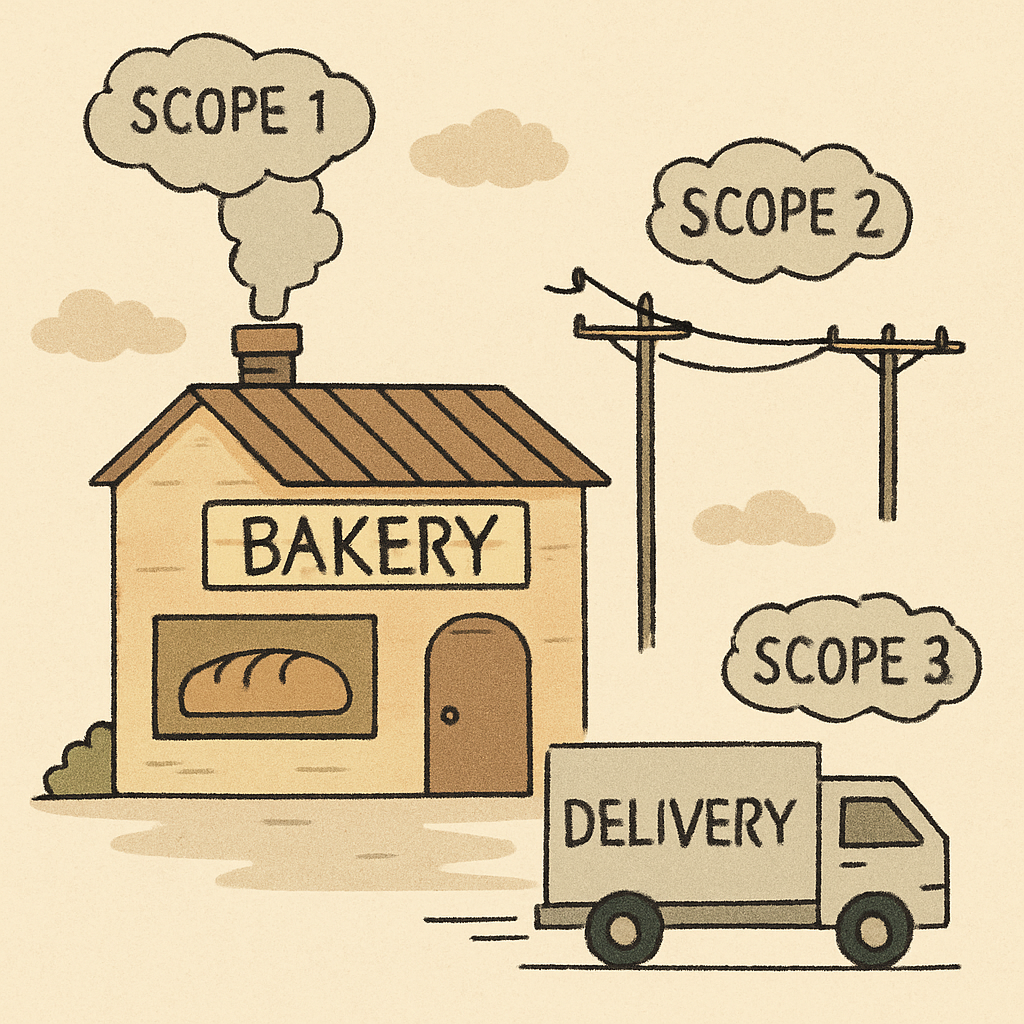
The trail of responsibility stretches even further, encompassing everything else in the supply chain that the bakery doesn't own but relies upon. Scope 3 covers the diesel burned by trucks delivering flour, the fertilizer used by farmers growing the wheat, and even the emissions from customers driving to the shop. For most modern companies, this massive "everything else" category represents over 70% of their total carbon footprint, making it the hardest to track but the most critical to disclose for honest transparency.
Ignoring these outer layers creates a dangerous financial blind spot for anyone holding stock. If a government introduces a carbon tax, a company that only reports its direct oven smoke (Scope 1) while hiding a massive supply chain footprint will face a sudden, crushing liability. Accurate reporting of all three scopes prevents these surprises, providing the raw data necessary to predict whether a business will thrive or collapse under future regulations.
Imagine planning for your retirement by asking, "What if the market crashes?" or "What if inflation doubles?" Smart companies perform a similar stress test called climate scenario analysis. Instead of guessing what might happen, they run simulations for different futures: one where temperatures rise moderately, and another where strict laws ban fossil fuels overnight. If an automaker only plans for a world that keeps buying gas engines, and regulations suddenly mandate electric vehicles, that business model collapses. Proper scenario analysis allows executives to prove they have a survival strategy for every outcome, reassuring you that your investment won't be caught off guard by a changing world.
When corporations fail to prepare for these shifts, they often end up holding stranded assets. Think of owning a warehouse full of unsold DVD players the year streaming took over—that inventory is technically an asset on paper, but practically worthless in reality. In the climate context, this could be a billion-dollar oil rig that becomes illegal to operate or a luxury ski resort that no longer gets snow. For your 401k, ignoring stranded asset risk is dangerous. You might think your savings are safe in a "stable" energy giant, only to watch its value evaporate because its expensive equipment became obsolete in a low-carbon economy.
Smart investing requires looking beyond today's profits to see if a corporation is honest about these long-term dangers. Reliable climate related financial disclosures act as your early warning system, separating the businesses that are future-proofing their operations from those ignoring the inevitable. However, interpreting these warnings is difficult when every company uses a different format. To solve this confusion, regulators are finally stepping in to create a universal standard for how this data must be shared.
For years, corporate climate reporting was like a "suggested donation" at a museum—nice to do, but legally optional. That era is ending as regulators demand hard numbers instead of vague promises. In the United States, the Securities and Exchange Commission (SEC) has moved to finalize strict rules that force public companies to treat climate risks as financial liabilities, not just public relations issues. These SEC climate-related rule requirements mean that if a CEO lies about their carbon footprint or flood risks, they could face the same serious legal penalties as if they lied about their bank balance.
Because business is global, we also need a common language that works everywhere from New York to Tokyo. Enter the International Sustainability Standards Board (ISSB). While the SEC watches over the U.S., the ISSB provides a universal playbook, creating a consistent way for companies to measure risks so investors can compare apples to apples. This ISSB global baseline for sustainability ensures that a car manufacturer in Germany and a tech giant in Brazil are answering the same questions, preventing them from hiding bad data behind local loopholes.
The shift to mandatory sustainability reporting standards changes the game for your portfolio. New mandatory filings differ from the old voluntary reports in three key ways:
Enforcement: Voluntary reports are self-graded; mandatory filings are legally binding and often audited.
Consequences: Exaggerations in voluntary reports might cause a social media scandal; lies in mandatory filings result in lawsuits and fines.
Completeness: Voluntary allows cherry-picking good news; mandatory requires disclosing the uncomfortable bad news too.
With these legal frameworks tightening, companies can no longer simply talk their way out of trouble—but some will still try to mislead you.
Just because a company claims to be "nature-positive" doesn't mean they aren't quietly polluting massive amounts of carbon behind the scenes. This practice, known as greenwashing, is the corporate equivalent of slapping a "healthy" label on a sugary cereal box to distract you from the nutrition facts. While tighter regulations are assisting in mitigating greenwashing in corporate filings, savvy readers must still act like detectives to find the truth. You need to look past the glossy photos of wind turbines and hunt for the boring, standardized data tables usually buried in the middle of the report.
Reliable data looks uncomfortable rather than pretty. When you scan a document, beware of adjectives like "ambitious" or "green" that lack hard numbers attached to them. Instead, search for a specific section often labeled "assurance" or "verification." This signifies that an independent auditor—an outside accountant who doesn't work for the CEO—has checked the math, much like a teacher grading a test to ensure no cheating occurred. Companies adhering to rigorous ESG reporting standards will clearly list who checked their pollution numbers and exactly how much waste they are responsible for.
Finding this truth requires skipping the colorful brochures on a brand’s homepage and downloading their "10-K" or annual financial report instead. Inside this dense legal document, usually under a section called "Risk Factors," companies are legally required to admit what threatens their business model. Here, the optimistic marketing vanishes, replaced by blunt climate risk reporting that tells you if rising sea levels could actually flood their warehouses. Once you know how to separate the polished promises from the audited liabilities, you are ready to use this information to protect your own financial future.
Just as a thorough foundation check is vital for homeownership, financial clarity is essential for responsible investing. By distinguishing between empty marketing and actual climate related financial risk disclosure, you have moved from a passive observer to an informed participant. You now possess the tools to see past green logos and identify which companies are genuinely preparing for a changing world.
It is time to turn this insight into protection for your wallet. Start your personal "financial home inspection" today:
Check your bank: Search their website for a "Climate Risk Report"—if it’s missing, ask why.
Scan your 401k: Review your fund's top holdings to see if they address transition risks or rely on outdated business models.
Demand clarity: Use your voice as a customer to request better sustainability transparency from the brands you trust.
You don't need a finance degree to safeguard your future; you just need to know which questions to ask. Personal risk management strategies are no longer just for corporate boardrooms—they are essential tools for your household. By demanding honest answers about climate exposure, you aren't just protecting your savings; you are enforcing a standard where truth is the most valuable asset of all.
Empty space, drag to resize