Why climate certification is essential for finance careers
Climate certification is no longer a niche credential reserved for environmental specialists. Finance and risk professionals are finding that regulatory pressure, investor expectations, and client demands are reshaping what it means to be qualified in 2026. The assumption that climate credentials only add theoretical knowledge is quickly proving outdated. These certifications now signal practical expertise in assessing systemic risk, evaluating ESG factors, and making informed investment decisions. This guide breaks down what climate certification involves, why it delivers real career and business value, how it compares to traditional finance credentials, and the concrete steps professionals can take to earn one.
Table of Contents
- What is climate certification and why is it gaining importance?
- Career and business benefits of earning climate certification
- Climate certification vs. traditional finance credentials: A comparison
- Key steps to obtain climate certification
- Our take: The overlooked value of climate certification in modern finance
- Boost your climate credentials with proven prep resources
- Frequently asked questions
Key Takeaways
| Point | Details |
|---|---|
| Certification fuels career growth | Obtaining a climate credential signals expertise that drives new job and leadership opportunities. |
| Regulatory and investor demand is rising | Clients and regulators increasingly require demonstrated climate risk literacy from professionals. |
| Practical skills and credibility | Climate certification builds hands-on skills in ESG investing, risk management, and compliance. |
| Clear roadmap to success | You can successfully prepare and obtain climate certification with the right study resources and guidance. |
What is climate certification and why is it gaining importance?
Climate certification refers to a formal credential that validates a professional’s knowledge of climate-related financial risks, sustainability frameworks, and ESG (environmental, social, and governance) integration. Unlike general finance qualifications, these certifications are designed specifically to address the intersection of environmental science, regulatory compliance, and investment strategy.
Two programs stand out as the most recognized in this space. The GARP Sustainability and Climate Risk (SCR) certification, offered by the Global Association of Risk Professionals, focuses on physical and transition climate risks, climate policy, and risk measurement methodologies. The CFA Institute’s ESG Investing (SIC) certification covers ESG analysis, stewardship, and the integration of sustainability factors into investment decisions. Both programs are built for finance professionals who need to apply these concepts in real-world portfolios and risk frameworks, not just understand them in theory.
“Professionals increasingly need recognized certifications to demonstrate climate risk expertise.” Earning a credential from programs like GARP SCR or CFA ESG signals to employers and clients that a professional has moved beyond surface-level familiarity with sustainability topics.
The demand for these credentials is accelerating for several interconnected reasons. Regulatory bodies across major markets are tightening requirements around climate-related financial disclosures. The Task Force on Climate-related Financial Disclosures (TCFD) framework, now embedded in regulatory guidance in the UK, EU, and increasingly in the US, requires firms to assess and report on physical and transition climate risks. Professionals who understand these frameworks are in short supply and high demand.
Institutional investors are also pushing asset managers and advisors to demonstrate credible ESG competency. A growing number of pension funds, sovereign wealth funds, and endowments now require evidence of climate literacy from their external managers. This is not a soft preference. It is increasingly written into mandates and due diligence questionnaires.
The knowledge domains covered by climate certifications are broad and practical. Professionals gain expertise in:
- Climate risk assessment: Identifying physical risks such as flooding and heat stress, and transition risks such as carbon pricing and stranded assets
- Sustainability frameworks: Understanding TCFD, the Sustainable Finance Disclosure Regulation (SFDR), and related reporting standards
- ESG integration: Applying ESG factors to portfolio construction, credit analysis, and risk modeling
- Governance and stewardship: Evaluating corporate governance structures and engaging with issuers on sustainability matters
Effective climate risk management strategies require exactly this kind of structured knowledge. Without formal training, professionals often rely on fragmented information, which creates blind spots in risk assessments and investment decisions.
Career and business benefits of earning climate certification
With the value of climate certification established, let’s explore the concrete ways these credentials can transform a career and strengthen a business.
For individual professionals, the most immediate benefit is improved employability. Roles in sustainable finance, ESG analysis, climate risk management, and green investment advisory are growing rapidly. Firms hiring for these positions increasingly list climate credentials as preferred or required qualifications. Holding a recognized certification signals that a candidate has invested in structured learning, passed a rigorous assessment, and can apply that knowledge from day one.

Certifications like GARP SCR and CFA ESG can elevate career prospects and organizational credibility in sustainable finance. The effect is visible at multiple career stages. Early-career professionals use these credentials to differentiate themselves in competitive job markets. Mid-career professionals leverage them to justify promotions or lateral moves into sustainability-focused roles. Senior professionals use them to lead ESG initiatives and build credibility with institutional clients.
The business-level benefits are equally significant. Consider the following comparison of outcomes for firms with and without certified ESG professionals:
| Business outcome | Firms with certified professionals | Firms without certified professionals |
|---|---|---|
| Client trust in ESG claims | High, supported by verifiable expertise | Lower, often reliant on marketing language |
| Regulatory compliance readiness | Proactive, structured approach | Reactive, higher risk of gaps |
| Market differentiation | Clear competitive advantage | Limited differentiation |
| Internal risk identification | Systematic and consistent | Ad hoc and inconsistent |
| Staff retention in ESG roles | Higher, due to development investment | Lower, limited career pathway |
Firms that invest in certification for their teams also benefit from reduced operational risk. When staff understand climate risk frameworks deeply, they are better positioned to identify exposures early, structure appropriate disclosures, and advise clients accurately. This reduces the likelihood of regulatory penalties, reputational damage, or mispriced risk in portfolios.
Pro Tip: Professionals who pair ESG certification courses with hands-on project experience, such as contributing to a firm’s TCFD report or ESG due diligence process, tend to see faster career advancement than those who hold the credential alone.
The market differentiation angle deserves particular attention. Clients, especially institutional ones, are increasingly sophisticated about ESG. They can distinguish between firms that have genuinely integrated sustainability expertise and those that have simply adopted the vocabulary. Certified professionals provide a verifiable signal of genuine competency. This is especially valuable in business development conversations, where a credential can reinforce a firm’s credibility in ways that a pitch deck alone cannot.
Exploring ESG investing foundations also reveals how deeply sustainability knowledge is reshaping capital allocation decisions, further reinforcing the business case for certified expertise across investment teams.
Climate certification vs. traditional finance credentials: A comparison
Many professionals already hold finance credentials, so where does climate certification fit in? Let’s compare.
Traditional finance credentials such as the CFA (Chartered Financial Analyst), FRM (Financial Risk Manager), and ACCA (Association of Chartered Certified Accountants) provide rigorous training in financial analysis, risk management, and accounting. These are foundational qualifications that remain highly respected and broadly applicable across the industry.
However, climate certifications address gaps left by classic finance certifications in sustainability and climate risk. Traditional programs were designed before climate risk became a mainstream financial concern. They do not systematically cover physical climate risk modeling, carbon market dynamics, transition risk scenario analysis, or ESG reporting standards. A CFA charterholder, for example, has deep expertise in valuation and portfolio management but may have limited formal training in how a 2-degree warming scenario affects a bond portfolio’s credit quality.
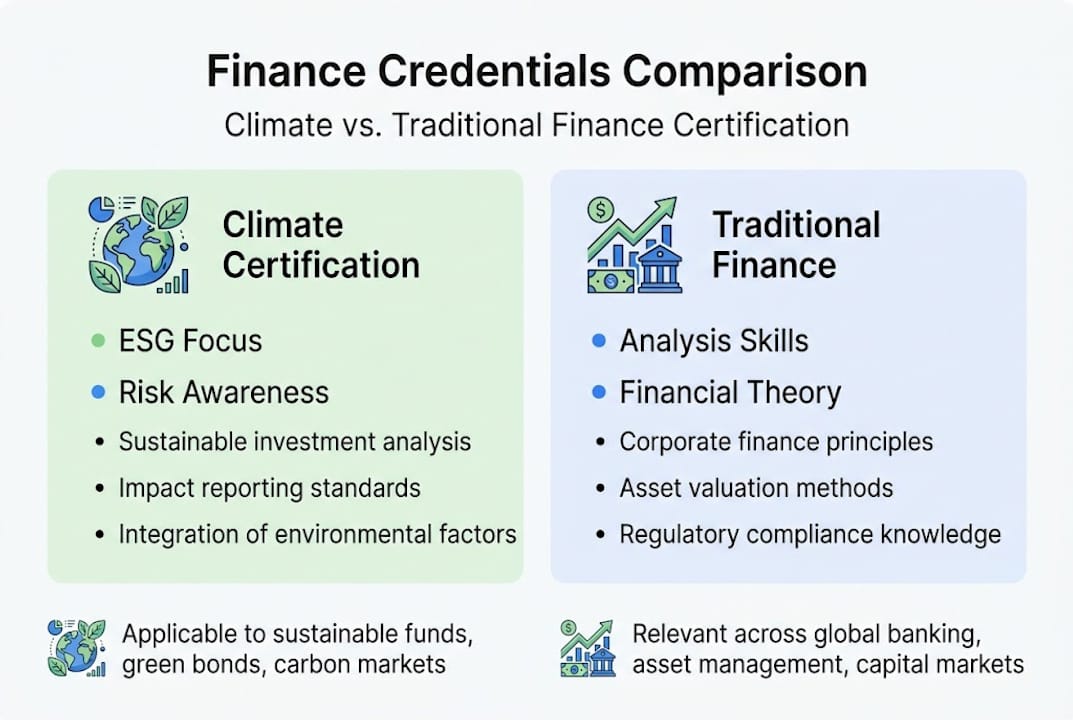
The following comparison highlights the key differences:
| Dimension | Traditional credentials (CFA, FRM) | Climate certifications (SCR, CFA ESG) |
|---|---|---|
| Core focus | Financial analysis, risk, accounting | Climate risk, ESG, sustainability |
| Climate risk coverage | Minimal or none | Extensive and structured |
| Regulatory alignment | General finance regulation | TCFD, SFDR, climate disclosure frameworks |
| ESG integration methods | Limited | Central to the curriculum |
| Complementarity | Strong foundation for climate overlay | Adds specialist depth to finance knowledge |
The most effective professionals in sustainable finance tend to hold both types of credentials. Here is how the combination works in practice:
- Foundation first: A traditional credential like the CFA or FRM establishes analytical rigor, financial modeling skills, and a deep understanding of markets and instruments.
- Specialist overlay: A climate certification then adds the specific knowledge needed to assess climate-related exposures, apply ESG frameworks, and meet regulatory expectations.
- Applied integration: Professionals who hold both can bridge the gap between conventional financial analysis and sustainability-focused decision-making, a skill set that is genuinely rare and highly valued.
- Leadership positioning: Combined credentials position professionals to lead ESG integration efforts within firms, advise clients on sustainable strategies, and contribute to regulatory engagement.
The FSA vs CFA ESG comparison illustrates how different climate credentials serve different professional needs, which is why selecting the right certification requires careful consideration of career goals and existing qualifications.
Key steps to obtain climate certification
With a clear understanding of why climate certification matters, here is how professionals can actually earn one.
1. Choose the right certification for your goals and background
The first step is selecting the program that aligns with your career objectives. The GARP SCR is well-suited for risk professionals who want to integrate climate risk into existing risk management frameworks. The CFA ESG certification is better suited for investment professionals who want to apply ESG analysis within portfolio management and advisory contexts. Professionals should review the syllabus of each program carefully and consider which knowledge domains are most relevant to their current or target role.
2. Assess your current knowledge and identify gaps
Before committing to a study plan, professionals should honestly evaluate their existing familiarity with climate science, regulatory frameworks, and ESG concepts. Many candidates find that their finance background is strong but their understanding of physical climate risk or carbon markets needs development. Identifying these gaps early allows for a more targeted and efficient study approach.
3. Build a structured study plan
Most candidates for the GARP SCR or CFA ESG certification require between 100 and 150 hours of preparation. Breaking this into weekly study sessions over three to four months is a realistic approach for working professionals. Allocating time specifically to weaker knowledge areas, rather than reviewing familiar material repeatedly, is a more efficient use of study hours.
4. Use high-quality prep resources
Pursuing climate credentials involves choosing the right certification, thorough preparation, and leveraging study aids. Structured prep courses, summary notes, and practice exams are particularly valuable because they align content with the actual exam syllabus. A free GARP SCR study guide is a useful starting point for professionals exploring the SCR curriculum before committing to a full course. For those ready to invest in structured preparation, a dedicated GARP SCR exam prep course provides video lessons, quizzes, and mock exams that mirror the actual exam format.
Pro Tip: Completing at least two full mock exams under timed conditions before the actual exam significantly improves performance. Mock exams reveal not just knowledge gaps but also time management weaknesses, which are just as important to address.
5. Register and sit the exam
Both the GARP SCR and CFA ESG exams are available online and can be scheduled at a time that suits the candidate. Registration fees and eligibility requirements vary, so professionals should check the official program websites for current details. The GARP SCR exam is computer-based and consists of multiple-choice questions, while the CFA ESG exam is also delivered online.
6. Leverage the credential after passing
Earning the certification is only the beginning. Professionals should update their LinkedIn profiles, add the credential to their resumes, and actively communicate their expertise to employers and clients. Joining professional networks of certified practitioners, contributing to industry discussions on climate risk, and applying the knowledge in day-to-day work all reinforce the value of the credential over time.
Our take: The overlooked value of climate certification in modern finance
The practical steps are clear, but the deeper value of climate certification is often underestimated. Most professionals approach these credentials as a compliance response or a resume enhancement. Both motivations are valid, but they miss something more significant.
Climate certification develops a fundamentally different way of thinking about risk. Finance professionals trained in traditional frameworks tend to assess risk within defined time horizons and using historical data. Climate risk does not behave this way. It is nonlinear, systemic, and long-tailed. Professionals who have worked through the SCR or CFA ESG curriculum genuinely think differently about portfolio resilience, counterparty exposure, and long-term value creation.
Clients and employers are beginning to recognize this distinction. A professional who can articulate how physical climate risk affects asset valuations in a specific geography, or how transition risk reprices a high-carbon sector, is not just credentialed. They are demonstrably more capable. Exploring resources on GARP SCR and CFA ESG success reinforces how rigorous preparation builds this deeper competency. Climate certification, at its best, is not a box to check. It is a genuine upgrade in professional judgment.
Boost your climate credentials with proven prep resources
Professionals who have read this far understand the career value and practical necessity of climate certification. The next step is structured, efficient preparation that fits a demanding professional schedule.
Green Risk Education offers syllabus-aligned climate certification courses for both the GARP SCR and CFA ESG exams, including bite-sized video lessons, detailed summary notes, quizzes, and full mock exams. Every resource is crafted by industry experts who understand what exam candidates actually need. For professionals exploring the ESG space, the ESG investing foundation course provides an accessible entry point into the core concepts that underpin both certifications. Start with a free resource or commit to a full prep course. Either way, the path to certification is clearly mapped.
Frequently asked questions
What are the most recognized climate certifications for finance professionals?
The GARP SCR and CFA ESG are widely recognized as the leading climate certifications for professionals in finance and risk management, valued by employers and institutional clients alike.
How does climate certification advance my finance career?
It demonstrates verified expertise in climate risk and ESG analysis, which enhances career opportunities and builds credibility with employers, regulators, and clients seeking qualified sustainability professionals.
Which skills will I gain from a climate risk certification?
Candidates develop practical skills in climate risk assessment, ESG integration, sustainable investment analysis, and regulatory compliance frameworks such as TCFD and SFDR.
Is prior experience required to pursue a climate certification?
Most programs are designed to be accessible to professionals from diverse finance backgrounds, with foundational content included to support candidates who are new to sustainability topics.
Recommended

Copyright © Green Risk Education 2026