Understand the GARP SCR Exam: Guide to Climate Risk Certification
Climate risk management is no longer confined to environmental departments. Across banking, insurance, asset management, and corporate strategy, professionals are being asked to assess, quantify, and communicate climate-related financial exposures. The GARP Sustainability and Climate Risk (SCR) exam was designed precisely for this shift. This guide breaks down what the SCR exam covers, how it compares to other leading credentials, and how professionals can prepare for it efficiently, without wasting time on study approaches that do not deliver results.
Table of Contents
- What is the GARP SCR exam?
- SCR exam structure and core topics
- SCR vs. CFA ESG and other sustainable finance certifications
- Efficient study strategies for the SCR exam
- A fresh perspective: Why SCR is the real game-changer for risk professionals
- Enhance your SCR exam preparation with targeted resources
- Frequently asked questions
Key Takeaways
| Point | Details |
|---|---|
| SCR exam explained | The SCR exam certifies your expertise in climate risk management for professionals worldwide. |
| Efficient study approach | Optimizing your workflow and using summary materials can dramatically improve your score and understanding. |
| Certification value | SCR distinguishes you in the market and is increasingly required by employers for sustainable finance roles. |
| Choosing the right cert | SCR focuses on climate risk, while CFA ESG covers broader ESG factors; knowing the difference helps guide your decision. |
| Practical application | Applying SCR concepts to real-world scenarios gives you a strong career advantage, not just exam success. |
What is the GARP SCR exam?
The SCR credential stands for Sustainability and Climate Risk, and it is issued by GARP, the Global Association of Risk Professionals. GARP is the same organization behind the widely respected Financial Risk Manager (FRM) designation, which gives the SCR immediate credibility within the global risk management community. The SCR exam was created in direct response to growing demand from financial institutions, regulators, and corporations for professionals who understand how climate change creates measurable financial risk.
The SCR is not a general environmental awareness qualification. It is a rigorous, practice-oriented credential that covers climate science, policy frameworks, scenario analysis methodologies, and the integration of climate risk into financial decision-making. These are exactly the skills that risk officers, portfolio managers, compliance professionals, and sustainability analysts need to perform effectively in a world where regulators are raising the bar on climate disclosure.
The exam is delivered in a computer-based, multiple-choice format. Candidates sit for 60 questions within a two-hour window, covering a broad range of topics organized into thematic sections. Reviewing SCR summary notes before registering can help candidates confirm that the syllabus aligns with their professional goals and existing knowledge base.
Why the SCR matters now:
- Regulatory frameworks such as the Task Force on Climate-related Financial Disclosures (TCFD) and the EU Taxonomy are reshaping how institutions report and manage climate risk.
- Central banks and financial supervisors globally are conducting climate stress tests, creating immediate demand for qualified specialists.
- Employers increasingly list climate risk literacy as a required, not preferred, competency for senior roles in risk and sustainability.
The SCR credential signals to employers that a professional has moved beyond awareness into genuine technical competency. That distinction is becoming more valuable every year.
SCR exam structure and core topics
With the basics covered, let us dig deeper into how the exam is structured and what candidates need to master.
The SCR exam is organized around thematic modules that together form a complete picture of how climate risk operates across scientific, regulatory, and financial domains. The table below summarizes the core topic areas and their approximate weighting within the exam:
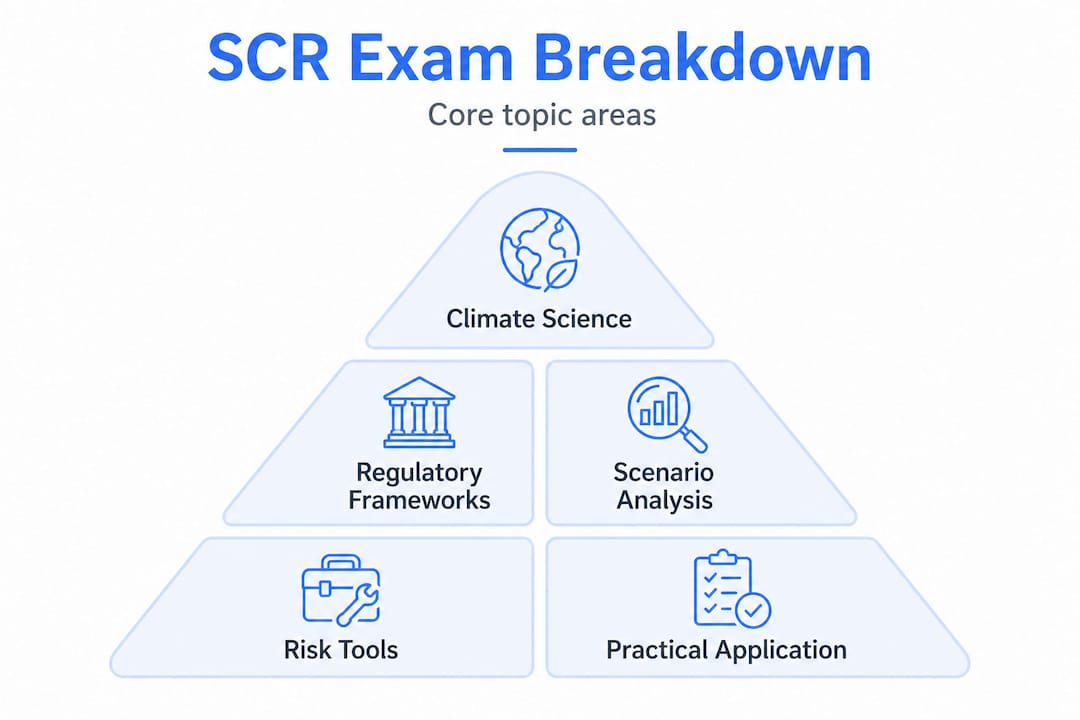
Understanding this distribution matters because it guides how candidates should allocate study time. Regulatory frameworks and scenario analysis together account for roughly 45% of the exam content. These sections reward candidates who understand not just definitions but how to apply concepts to realistic situations.
The exam format itself is fairly accessible. Sixty questions in two hours means candidates have approximately two minutes per question. Speed and accuracy both matter. Building an efficient exam workflow before exam day is just as important as mastering the content.
Recommended preparation steps:
- Download a structured syllabus overview and map your existing knowledge against each topic area.
- Study climate science fundamentals first, as they underpin every other module.
- Move into regulatory frameworks and TCFD, focusing on the four pillars: governance, strategy, risk management, and metrics.
- Practice scenario analysis questions using case studies and worked examples.
- Complete timed mock exams in the final phase of preparation to simulate real conditions.
- Review weak areas using targeted summary notes PDF resources before your exam date.
Pro Tip: Focus extra attention on regulatory frameworks and scenario analysis during study sessions. These two areas are consistently high-weighted and require applied thinking, not just recall. Many candidates underestimate the scenario analysis section and lose points that could be recovered with targeted practice.
The SCR exam rewards professionals who can connect theory to practice. Simply memorizing definitions will not get candidates across the pass mark. Understanding how regulatory frameworks translate into actual risk management decisions is what separates successful candidates from those who need to resit.
SCR vs. CFA ESG and other sustainable finance certifications
Once candidates understand the exam itself, it is important to see how it compares to other leading credentials in sustainable finance. The two most frequently compared qualifications are the GARP SCR and the CFA Institute Certificate in ESG Investing (often called the CFA ESG or SIC certificate).
Both credentials address sustainability themes, but they serve different professional purposes and attract different candidate profiles. Understanding this distinction helps professionals choose the path that best fits their career trajectory.
| Feature | GARP SCR | CFA ESG (SIC) |
|---|---|---|
| Primary focus | Climate risk management | Broad ESG investing principles |
| Exam format | 80 questions, 4 hours | 100 questions, 2.2 hours |
| Ideal for | Risk managers, compliance officers, sustainability analysts | Investment analysts, portfolio managers, wealth advisors |
| Regulatory alignment | TCFD, Basel climate frameworks, EU Taxonomy | PRI, ESG reporting standards, investment stewardship |
| Global recognition | Strong in risk management and financial sectors | Strong in investment management and advisory |
| Pass rate comparison | See SCR exam pass rates | See CFA ESG vs SCR pass rates |
The SCR is narrower in scope but deeper in its treatment of climate risk specifically. For professionals working in risk departments, regulatory compliance, or climate strategy roles, the SCR is often the more directly applicable credential. For investment professionals who need to integrate ESG factors across a portfolio, the CFA ESG certificate may be a better starting point.
“The demand for climate risk expertise in financial services is accelerating faster than the supply of qualified professionals. Institutions that invest in certifying their teams now will have a significant competitive advantage as climate disclosure requirements tighten globally.”
Some professionals pursue both credentials over time, and this combination is increasingly recognized as a strong signal of cross-functional sustainability expertise. The CFA ESG vs SCR guide provides a detailed breakdown for candidates weighing this decision.
Key advantages of the SCR credential:
- Directly aligned with emerging regulatory requirements including TCFD and Basel climate risk guidelines.
- Shorter exam format makes it achievable alongside demanding professional schedules.
- Strong relevance to risk management career paths, which are growing rapidly across financial institutions.
- Recognized internationally, making it transferable across markets.
Efficient study strategies for the SCR exam
Armed with an understanding of the exam’s context and content, the next step is exploring the most effective ways to prepare and maximize the chances of success.
The most common mistake candidates make is treating SCR preparation like general test-taking. They read through the full curriculum sequentially, take light notes, and then wonder why they struggle with practice questions. The SCR rewards candidates who study actively, not passively. That means engaging with material through application rather than just reading.
Proven study strategies for SCR success:
- Use summary notes strategically. Dense textbooks can slow progress. Focused SCR summary notes PDF resources condense the key concepts without sacrificing depth, making review sessions far more efficient.
- Run practice tests early. Many candidates save mock exams for the final week of study. Starting practice tests earlier reveals knowledge gaps sooner and allows time for targeted remediation.
- Focus on scenario-based thinking. SCR questions often require applying a framework to a real-world situation. Practicing question answering strategies that simulate exam conditions builds this muscle faster than rereading theory.
- Allocate time by topic weight. Not all modules carry equal weight. Using a structured exam workflow that mirrors the exam’s actual distribution ensures study time is spent where it matters most.
- Track progress systematically. After each practice session, log which question types were answered correctly and which were missed. Patterns in mistakes often reveal conceptual gaps that need targeted attention.
Pro Tip: Joining a study group or online community of SCR candidates provides both accountability and exposure to diverse interpretations of challenging topics. Discussing a regulatory framework concept with a peer often clarifies nuances that a solo study session misses entirely.
Avoid two traps that derail many candidates. The first is rote memorization without context. Knowing that TCFD stands for Task Force on Climate-related Financial Disclosures is far less useful than understanding what each of the four TCFD pillars requires organizations to report. The second trap is neglecting scenario analysis practice. This section feels unfamiliar to many candidates, especially those without a quantitative background, but consistent practice with worked examples significantly improves performance.
Detailed guidance on structuring a complete study plan, including timing, resources, and review cycles, is available in the exam success advice resources published by Green Risk Education.
A fresh perspective: Why SCR is the real game-changer for risk professionals
There is a tendency in professional development circles to view broader credentials as inherently more valuable than specialized ones. More topics covered must mean more knowledge gained, and therefore more career benefit. That logic sounds reasonable but often breaks down in practice, particularly in technical fields like climate risk management.
The SCR certification challenges this assumption directly. Its narrow focus on climate risk is not a limitation. It is precisely what makes it valuable. When a risk officer sits across the table from a regulator conducting a climate stress test, that officer needs deep, applied knowledge of climate scenario methodologies and regulatory expectations. A broad ESG overview credential does not deliver that. The SCR does.
Industry professionals who have earned the SCR describe a clear shift in how they are perceived internally. The credential signals technical fluency in a domain that most senior leaders in financial institutions still find genuinely challenging. That positioning creates real leverage. Boards and executive committees are actively looking for people who can translate climate science into financial risk language, and SCR holders are equipped to do exactly that.
The practical career case for the SCR is detailed in the SCR ROI guide, which tracks how the credential translates into concrete professional outcomes. For a broader analysis of whether certification investment pays off, the SCR investment analysis covers the financial and career case in depth.
What is often overlooked is that the SCR is not purely a career advancement tool. Professionals who study seriously for this exam report that the knowledge itself changes how they approach their work. Scenario analysis thinking, applied climate science, and regulatory awareness become integrated into everyday professional judgment. That shift in thinking is arguably the most underrated benefit of the credential.
Pro Tip: Approach SCR preparation with the intention of applying each concept to real decisions, not just passing an exam. Professionals who study this way retain more, perform better on the exam, and extract greater long-term value from the credential.
Enhance your SCR exam preparation with targeted resources
To apply these strategies and insights, take advantage of curated resources that make SCR preparation truly efficient. Green Risk Education has built a complete preparation ecosystem specifically for the SCR exam, designed by industry experts who understand both the content and the demands of busy professional schedules.
Structured SCR prep courses provide step-by-step guidance through every topic area, using bite-sized instructional videos that fit into a working professional’s day. Free free SCR summary notes give candidates a 70-page distillation of the full syllabus, ideal for review and quick reference. Full-length SCR mock exams replicate the actual exam experience, helping candidates build both knowledge and exam-day confidence. Every resource is syllabus-aligned and built to move candidates efficiently from study to success.
Frequently asked questions
How long does the SCR exam take and what is its format?
The SCR exam is a computer-based, multiple-choice test with 60 questions and a two-hour time limit, giving candidates approximately two minutes per question.
What topics are covered in the SCR exam?
Major topics include climate science, regulatory frameworks such as TCFD, scenario analysis methodologies, and climate-related financial risks across both physical and transition risk categories.
Is the SCR exam recognized internationally?
Yes, SCR is recognized globally as a leading climate risk management credential, with particular strength in financial services, banking, and corporate sustainability sectors.
Where can I find free study materials for the SCR exam?
Candidates can download free SCR summary notes from Green Risk Education, a 70-page PDF covering the full exam syllabus.
What is the pass rate for the SCR exam?
SCR exam pass rates are published annually and provide useful context for setting realistic preparation timelines and benchmarking study progress.
Recommended

Copyright © Green Risk Education 2026