Top CFA SIC exam preparation tips for ESG success
The CFA Institute’s Sustainable Investing Certificate (SIC) exam is not a straightforward credentialing test where memorizing a glossary will carry candidates to a passing score. The exam centers on applied ESG decision-making where disclosure can be incomplete and different ratings or disclosures can disagree, demanding that candidates reason through ambiguity rather than simply recall facts. For professionals already working in investment management, risk analysis, or sustainability roles, this distinction matters enormously. The strategies that work for traditional finance exams often fall short here. This article delivers targeted, practical preparation guidance designed to close that gap.
Table of Contents
- Understand the CFA SIC exam’s unique challenges
- Build a repeatable study workflow for ESG scenarios
- Practice with applied ESG mock exams and question banks
- Master foundational ESG frameworks and reasoning patterns
- Why flexible reasoning beats memorization for ESG exam prep
- Accelerate your CFA SIC exam prep with targeted courses
- Frequently asked questions
Key Takeaways
| Point | Details |
|---|---|
| Prioritize workflow thinking | Develop a repeatable decision-making process to handle incomplete or conflicting ESG data. |
| Practice with real scenarios | Use realistic mock exams and question banks to hone applied ESG reasoning skills. |
| Master key ESG frameworks | Summarize and understand the core strengths and limits of popular ESG reporting frameworks. |
| Flexible analytics matter | Memorization helps, but flexible reasoning under uncertainty is what distinguishes top CFA SIC candidates. |
Understand the CFA SIC exam’s unique challenges
The first thing candidates should recognize is that the CFA SIC exam operates on a fundamentally different logic than most professional credentialing tests. Standard finance exams typically reward candidates who can retrieve formulas, define terms, and apply fixed models. The CFA SIC is built around something harder: evaluating real ESG scenarios where the information available is often imperfect.
“The test is designed around applied ESG decision-making where disclosure can be incomplete and different ratings and disclosures can disagree.” — Sustainable Investing Certificate Study Guide
This design reflects what ESG professionals actually encounter on the job. A company might disclose Scope 1 emissions while omitting Scope 3. Two major ESG rating agencies might assign the same firm dramatically different scores because they weight governance factors differently. The exam tests whether a candidate can navigate these realities, not whether they can recite a definition.
What this means practically is that candidates who rely purely on traditional study methods, such as flashcards, definition lists, or formula sheets, are unlikely to perform at the level the exam demands. The skills being assessed include:
- Identifying what information is missing from an ESG disclosure and why it matters
- Weighing conflicting ESG ratings using structured reasoning rather than instinct
- Selecting the most defensible course of action when no perfect answer exists
- Recognizing the limitations of common ESG disclosure frameworks under real-world constraints
- Communicating reasoning clearly under time pressure
These are analytical competencies, not memory tasks. Developing them requires deliberate practice with the right kinds of questions and a structured approach to handling uncertainty.
Pro Tip: Build the habit of practicing with partial datasets. Take a case study and deliberately remove some data points, then work through it anyway. This trains the cognitive flexibility the exam rewards.
With this foundation, let’s look at how to build an adaptive and efficient study workflow.
Build a repeatable study workflow for ESG scenarios
One of the most important insights from structured ESG exam preparation is that a repeatable workflow and reasoning under messy information, rather than memorizing definitions, is what separates high-performing candidates from those who struggle with scenario-based questions.

A repeatable workflow means having a consistent, step-by-step mental process that candidates apply to any ESG question, regardless of the specific sector, company, or issue presented. Think of it as a decision framework that works reliably even when the inputs vary. Developing this workflow early in preparation and then testing it repeatedly is one of the highest-value investments a candidate can make.
Here is a practical step-by-step workflow for evaluating CFA SIC scenario questions:
- Identify the scenario’s scope and stakeholders. Who are the relevant parties? What are their interests? Is this a governance question, an environmental disclosure issue, or a social materiality concern?
- Catalog what information is present. Note the data and disclosures actually provided in the scenario. Be explicit about what you have to work with.
- Identify gaps and conflicts. What is missing? If multiple data sources are provided, do they agree? If they conflict, why might they differ?
- Apply relevant frameworks. Which ESG standard or reporting framework is most applicable here? How does it inform the analysis?
- Evaluate alternatives. Generate at least two plausible interpretations or courses of action. Avoid jumping to the first answer that seems reasonable.
- Select the most defensible conclusion. Choose the answer best supported by the available evidence and your framework knowledge, while acknowledging the limitations of incomplete data.
Integrating this kind of structured thinking into study sessions takes practice. Applying ESG integration strategies within each step of the workflow reinforces both conceptual understanding and exam-ready reasoning.
| Workflow stage | Key questions to ask | Common pitfalls |
|---|---|---|
| Scope and stakeholders | Who is affected? What is at stake? | Overlooking indirect stakeholders |
| Available information | What data is explicitly given? | Assuming data that isn’t stated |
| Gaps and conflicts | What is missing? Why do ratings differ? | Ignoring contradictions in the data |
| Framework application | Which standard applies? What does it require? | Applying the wrong framework |
| Alternative evaluation | What else could this mean? | Anchoring on the first interpretation |
| Conclusion selection | What is best supported by evidence? | Overconfidence with partial information |
Using effective study schedule tips alongside this workflow helps candidates allocate time wisely across each stage, ensuring no step gets neglected during preparation.
Pro Tip: After completing each practice question, write one sentence summarizing the reasoning gap that would separate a strong answer from a weak one. This reflection step accelerates pattern recognition significantly.
Once you have a workflow, you need the right resources and question types to practice with.
Practice with applied ESG mock exams and question banks
Regular, timed practice with scenario-based questions is one of the most powerful tools available to CFA SIC candidates. The research is clear: candidates who commit to structured, timed practice and workflow-focused preparation improve their performance substantially over those who rely on passive review alone. In fact, consistent engagement with full timed mock exams can improve candidate scores by as much as 20%, according to testing research across professional certification programs.
Not all practice resources are created equal. The most valuable question banks for the CFA SIC share specific characteristics:
- Questions are scenario-based, not definition-recall style
- Cases feature incomplete or conflicting data that mirrors real-world ESG reporting
- Explanations address why wrong answers are wrong, not just why correct answers are correct
- Coverage spans all major ESG topic areas, including governance, environmental factors, social considerations, and integration methods
- Timed mock exams replicate the actual exam’s pressure and pacing
The following comparison highlights key features candidates should evaluate when selecting practice resources:
| Resource type | Format | ESG scenario coverage | Time-pressure simulation | Cost range |
|---|---|---|---|---|
| Full mock exam questions | Timed, full-length | Strong | Yes | Varies |
| Topic-specific question banks | Untimed or timed sets | Moderate to strong | Partial | Varies |
| Textbook end-of-chapter questions | Untimed | Moderate | No | Included with text |
| Peer study group exercises | Self-paced | Variable | No | Free |
| Free ESG mock exam | Timed sample set | Moderate | Yes | Free |
Candidates who want to track their progress and identify weak areas should consult resources available through the ESG exam insights blog, which regularly features analysis of common question patterns and reasoning traps. Regular self-assessment, rather than passive reading, builds the kind of active analytical confidence the exam demands.
One underappreciated element of mock exam practice is reviewing incorrect answers with genuine rigor. When a candidate selects a wrong answer, the goal is not simply to note the correct one and move on. The more productive approach is to trace exactly where the reasoning broke down. Was it a misidentification of the relevant framework? An assumption about missing data? An overconfidence in a single rating source? Mapping these reasoning errors systematically turns every mistake into a targeted improvement opportunity.
To round out your preparation, it’s essential to solidify core ESG concepts in context.
Master foundational ESG frameworks and reasoning patterns
ESG frameworks are the analytical vocabulary of the CFA SIC exam. Candidates who know not just what these frameworks are but how they differ, when each is most applicable, and where they fall short will consistently outperform those who have only surface-level familiarity.
The frameworks most frequently relevant to the exam include:
- SASB (Sustainability Accounting Standards Board): Industry-specific standards that identify financially material ESG topics for different sectors. SASB is particularly useful when analyzing which ESG disclosures are most relevant to a specific business model.
- TCFD (Task Force on Climate-related Financial Disclosures): A framework structured around governance, strategy, risk management, and metrics and targets. TCFD is central to climate risk analysis and is increasingly referenced by regulators globally.
- GRI (Global Reporting Initiative): A broad, stakeholder-focused reporting framework that covers economic, environmental, and social impacts. GRI tends to be more expansive than SASB and is widely used for corporate sustainability reporting.
- ISSB (International Sustainability Standards Board): A newer standard-setting body developing global baseline sustainability disclosures, building on TCFD concepts.
- UN PRI (Principles for Responsible Investment): A set of voluntary commitments for investors integrating ESG considerations into their decision-making processes.
Understanding ESG investing foundations across these frameworks is not a passive exercise. Candidates should be able to explain, in their own words, what each framework is designed to accomplish, who it serves, and where its limitations lie. That depth of understanding is what a repeatable workflow and reasoning approach makes possible, rather than definition memorization alone.
A high-value study habit is creating a one-page comparison for each major framework covering: purpose, primary audience, disclosure scope, strengths, and known weaknesses. When practice questions reference these frameworks, candidates with this preparation can instantly place them in context rather than trying to reconstruct the comparison under time pressure.
Pro Tip: For each ESG framework, write a two-sentence “limitation note” from the perspective of an investor who relies on it. This forces a critical analytical lens that directly mirrors the exam’s applied reasoning demands.
With this knowledge in hand, tying all the elements together into a personalized exam prep strategy is the final and most important step.
Why flexible reasoning beats memorization for ESG exam prep
There is an uncomfortable truth that circulates through the professional certification space: most candidates prepare for exams the way they were taught to study in school. They make flashcards. They highlight definitions. They read chapters repeatedly until the words feel familiar. For many credentials, this works reasonably well. For the CFA SIC, it represents a significant strategic error.
The exam, by design, rewards clear reasoning when information is imperfect, not perfect recall of facts. This is not a minor distinction. It fundamentally changes what productive preparation looks like. Examiners are not asking “What does TCFD stand for?” They are presenting situations where two analysts have reached opposite conclusions using the same incomplete dataset, and asking which reasoning process is more defensible.
The professionals who perform best on this exam tend to be those who regularly practice analytical reasoning under uncertainty in their actual jobs. They are accustomed to advising clients or internal stakeholders when the ESG data is contradictory or unavailable. They have built mental frameworks for structuring that ambiguity into actionable conclusions. The exam rewards exactly that skill.
For candidates who do not yet have that professional experience depth, the solution is deliberate simulation. It means choosing practice materials that force genuine reasoning rather than answer recognition. It means reviewing not just what the correct answer was, but modeling out why each incorrect answer looked plausible and where its logic failed. Resources like ESG exam success strategies can provide additional structure for building this kind of exam-ready analytical mindset.
The candidates who treat the CFA SIC as a reasoning credential rather than a knowledge credential are the ones who walk out of the exam feeling prepared rather than surprised. The preparation investment looks different, but the return is more durable.
Accelerate your CFA SIC exam prep with targeted courses
Green Risk Education offers a structured path for professionals who want to build genuine ESG reasoning skills rather than surface-level familiarity. The CFA ESG Investing Course is built around the exact workflow-based, scenario-driven approach this article has outlined. It delivers bite-sized instructional videos, detailed summary notes, and applied practice assessments that mirror the real exam’s demands, all crafted by industry experts who understand the analytical depth the credential requires.
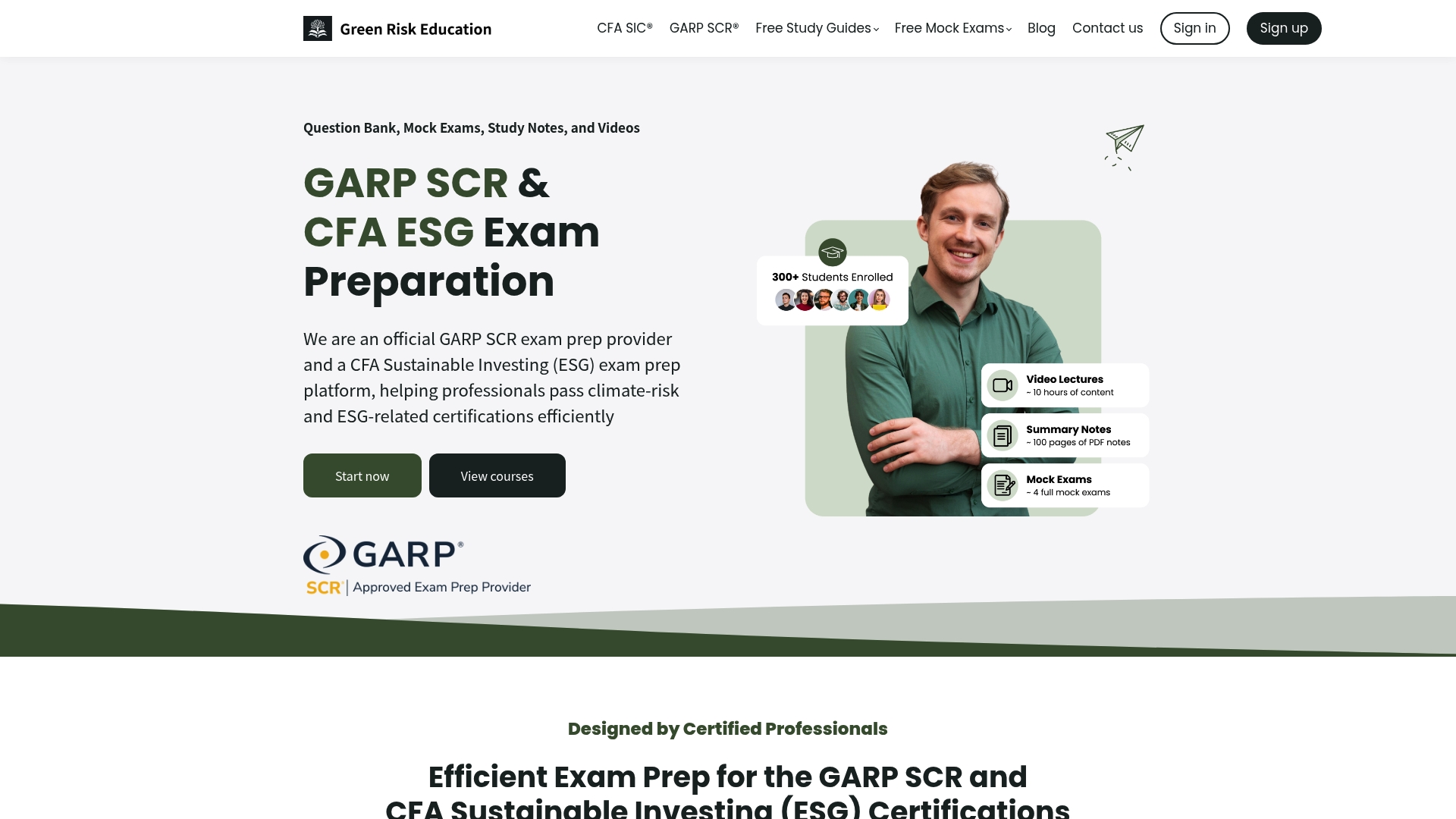
Candidates looking to build a solid conceptual base can also explore the ESG Foundations Course, which aligns foundational knowledge with the frameworks most relevant to CFA SIC questions. For those who want to experience the platform’s approach before committing, a free mock exam is available and provides immediate exposure to scenario-based ESG questions in a timed environment. The next step toward passing the CFA SIC starts with choosing preparation resources that match the exam’s actual demands.
Frequently asked questions
How is the CFA SIC exam different from the standard CFA exams?
The CFA SIC emphasizes applied ESG reasoning where information may be incomplete or conflicting, with exam difficulty driven by disagreement and imperfect disclosures, unlike standard CFA exams which are more definition and formula-driven.
What’s the best way to practice for ambiguous ESG questions?
Work through realistic mock exams and build a repeatable workflow for handling conflicting or missing data, rather than focusing primarily on memorizing terms and definitions.
Are there free ESG mock exams available?
Yes, free CFA ESG mock exams are available through Green Risk Education’s free mock exam offering, featuring scenario-based practice questions designed to mirror the actual exam format.
Which ESG frameworks should I prioritize for the CFA SIC exam?
Prioritize SASB, TCFD, and GRI, as these are the frameworks most commonly referenced in sustainable investing context questions, and build repeatable reasoning around them rather than simply memorizing their definitions.
Recommended

Copyright © Green Risk Education 2026