Sustainable finance: Risk, exams, and career opportunity
Sustainable finance has moved from the margins of portfolio theory into the operational core of financial institutions worldwide. Risk departments, regulators, and exam bodies have all updated their expectations accordingly, and finance professionals who treat climate risk as a peripheral concern are finding themselves at a growing disadvantage. The GARP Sustainability and Climate Risk (SCR) exam and the CFA Institute’s Certificate in ESG Investing (SIC) both reflect this shift, testing candidates on frameworks that are now embedded in real regulatory guidance. This article clarifies what sustainable finance actually means in practice, how it appears on exams, and where the sharpest career opportunities lie.
Table of Contents
- The evolution of sustainable finance in financial institutions
- ESG versus enterprise climate risk: What finance professionals must know
- Scenario analysis: The practical backbone of sustainable finance skills
- Regulatory and governance frameworks: Why climate risk is now mainstream
- The real competitive edge: Insights most candidates overlook
- Advance your skills with tailored sustainable finance prep
- Frequently asked questions
Key Takeaways
| Point | Details |
|---|---|
| Regulatory integration | Sustainable finance is now mandated by regulators and institutions, reshaping finance roles and exam content. |
| ESG vs climate risk | Recognizing the difference between ESG investing and enterprise climate risk is crucial for exams and career advancement. |
| Scenario analysis mastery | Scenario analysis is central to sustainable finance, requiring nuanced methodology and real-world application skills. |
| Frameworks drive careers | Familiarity with governance and disclosure frameworks gives finance professionals a career and exam advantage. |
| Practical prep matters | Strategic, real-world learning prepares you for both exam success and evolving finance job requirements. |
The evolution of sustainable finance in financial institutions
Sustainable finance is not simply a rebranding of socially responsible investing. It has evolved into a structured discipline that reshapes how institutions identify, measure, and manage material financial risks. Over the past decade, central banks, prudential regulators, and multilateral bodies have issued binding and guidance-based requirements that place climate risk squarely inside mainstream risk management. That shift has consequences for every professional working in credit, treasury, investment management, or enterprise risk.
The practical driver behind this evolution is the recognition that climate-related events generate measurable financial losses. Physical risks, including floods, droughts, and extreme heat, affect asset valuations, collateral quality, and insurance liabilities. Transition risks, such as carbon pricing, stranded asset exposure, and shifts in consumer demand, affect entire sectors’ earnings profiles and long-term solvency. As climate certification becomes more valuable, understanding both risk categories is essential for candidates sitting for the SCR or CFA SIC.
Regulators have responded forcefully. In Canada, the Office of the Superintendent of Financial Institutions (OSFI) has issued detailed climate guidance stating that institutions are expected to integrate physical and transition climate risks into risk appetite, enterprise risk management, data and metrics, and scenario analysis frameworks. This is not aspirational language. It is regulatory expectation, and similar mandates now exist across the European Union, the United Kingdom, and several Asian jurisdictions.
What does this mean for large institutions? It means that sustainable business practices are no longer isolated to sustainability departments. Credit officers assess climate exposure in lending decisions. Treasury teams factor transition risk into liability management. Investment committees review climate scenario outputs before making allocation decisions. The organizational footprint of sustainable finance now touches nearly every function.
Key areas where institutions are operationalizing climate risk include:
- Risk appetite frameworks: Climate-related risk tolerance statements are being added alongside credit, market, and liquidity risk tolerances.
- Data and metrics: Institutions are investing in emissions data, physical risk mapping tools, and sector-level transition exposure metrics.
- Enterprise risk management (ERM): Climate risks are being formally embedded in ERM taxonomies, replacing informal or separate sustainability reporting.
- Scenario analysis: Structured scenario exercises are used to test resilience under different climate pathways, from orderly transition to physical risk extremes.
The future of sustainable investing increasingly depends on professionals who can operate fluently within these systems, not just those who understand ESG ratings or green bond structures.
ESG versus enterprise climate risk: What finance professionals must know
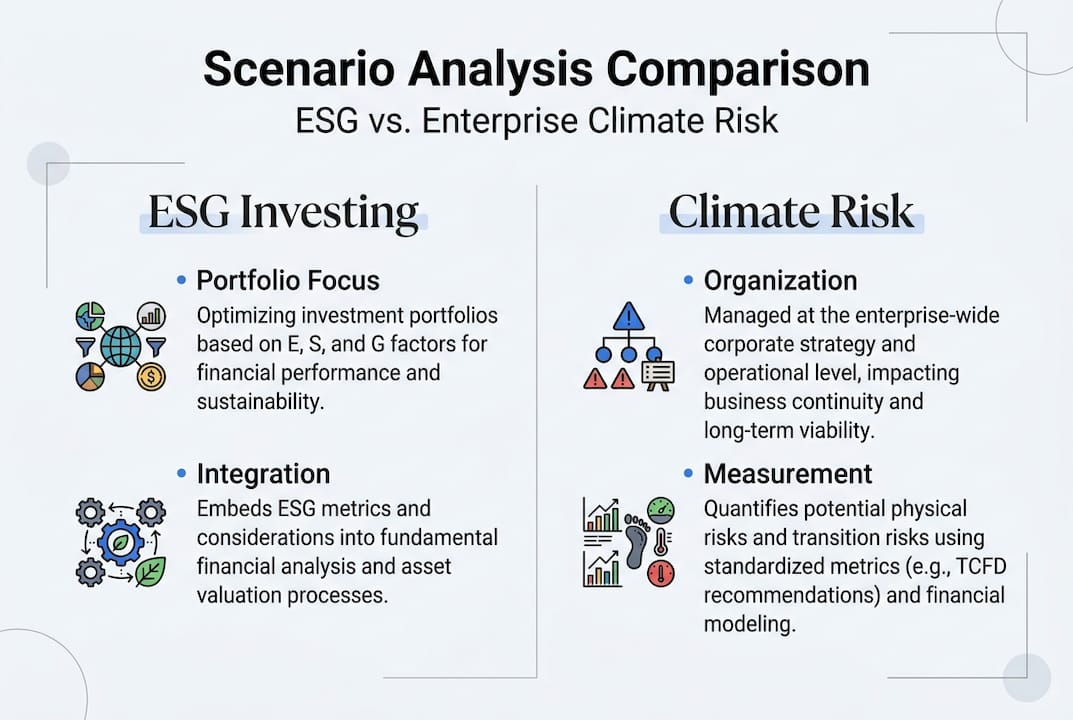
One of the most persistent sources of confusion among exam candidates and early-career professionals is the conflation of ESG investing with enterprise climate risk management. These are related but distinct disciplines. Treating them as synonymous leads to errors in both exam answers and real-world workflows.
ESG integration, in its investment context, refers to the systematic incorporation of environmental, social, and governance factors into the investment analysis and portfolio construction process. The goal is to improve risk-adjusted returns or align portfolios with specific values or mandates. Data inputs include ESG ratings, carbon footprint metrics, governance scores, and supply chain exposure assessments. The decision-making unit is typically the portfolio manager or investment analyst.
Enterprise climate risk management, by contrast, operates at the organizational level. Its focus is on measuring the institution’s own exposure to climate-related risks across its business lines, assets, and liabilities. It involves governance structures, board-level oversight, internal controls, regulatory reporting, and stress testing. The decision-making unit spans the chief risk officer, the board, and the regulator. As OSFI guidance makes clear, institutions are expected to treat climate risk integration as an enterprise-wide responsibility, not an investment team function.

The table below summarizes the key distinctions:
| Dimension | ESG investing | Enterprise climate risk |
|---|---|---|
| Scope | Investment portfolio | Entire institution |
| Primary users | Portfolio managers, analysts | Risk officers, boards, regulators |
| Key data inputs | ESG ratings, carbon footprints | Physical risk maps, transition scenarios |
| Decision outputs | Allocation, weighting, exclusion | Risk appetite, capital planning, disclosure |
| Exam relevance | CFA SIC primary focus | GARP SCR primary focus |
| Regulatory driver | Stewardship codes, labeling rules | Prudential regulation, supervisory guidance |
For exam candidates, this distinction carries direct consequences. The CFA SIC exam tests ESG integration strategies at the portfolio and investment process level. The GARP SCR exam tests enterprise-level climate risk frameworks, including governance, scenario analysis, and regulatory alignment. Understanding which exam tests which methodology is the first step in building an effective study plan. A detailed CFA vs. GARP SCR comparison can help candidates choose the credential that best fits their career trajectory.
Pro Tip: When reviewing case studies in either exam, identify whether the scenario describes an investment decision or an institutional risk management process. The correct analytical framework depends entirely on that distinction.
Understanding ESG investing foundations builds the baseline, but professionals who can operate in both domains, investment ESG and enterprise climate risk, command the strongest market positioning.
Scenario analysis: The practical backbone of sustainable finance skills
Climate scenario analysis is the methodology that transforms abstract climate concerns into structured, quantifiable inputs for financial planning and risk assessment. It is central to exam content for both the GARP SCR and CFA SIC, and it is equally central to how regulators expect institutions to demonstrate climate risk management capability.
At its core, scenario analysis involves selecting a set of plausible future climate pathways and assessing how an institution or portfolio would perform under each one. The Network for Greening the Financial System (NGFS) has produced the most widely referenced scenarios for this purpose. According to NGFS guidance, climate scenario analysis is a core methodology used to translate climate uncertainty into structured risk assessment and planning, making it a foundational skill for anyone working in sustainable finance.
The practical steps in a rigorous scenario analysis exercise include:
- Define the objective: Is the exercise designed to assess credit risk, market risk, liquidity risk, or strategic resilience? The objective shapes every subsequent methodological choice.
- Scope materiality: Not every climate risk is material to every institution. Materiality scoping identifies which sectors, geographies, and risk types warrant detailed analysis.
- Select scenarios: Practitioners typically run at least three scenarios: an orderly transition, a disorderly transition, and a hot-house world scenario where limited policy action leads to severe physical risks.
- Set the time horizon: Short-term horizons (three to five years) capture transition risks more precisely. Long-term horizons (thirty or more years) are needed to capture physical risk accumulation.
- Apply quantitative and qualitative methods: Financial impact estimation may use sector-level carbon cost models, asset valuation adjustments, or credit loss projections. Qualitative assessment covers governance gaps, reputational exposure, and operational vulnerabilities.
- Validate assumptions and communicate limitations: Regulators expect scenario outputs to be accompanied by clear documentation of assumptions, data gaps, and model limitations.
NGFS guidance further emphasizes that mastering scenario methodology involves methodology choices, not just climate facts. Candidates who memorize climate pathways without understanding how to apply them in structured analysis will underperform on exam questions that test practical application.
The table below illustrates how scenario selection affects risk focus:
| Scenario type | Temperature pathway | Key risk emphasized | Time horizon sensitivity |
|---|---|---|---|
| Orderly transition | 1.5°C to 2°C | Transition risk | Near to medium term |
| Disorderly transition | 2°C to 3°C | Both physical and transition | Medium term |
| Hot-house world | 3°C+ | Physical risk | Long term |
Effective resources for climate risk management strategies provide structured frameworks that mirror this kind of applied thinking. Professionals preparing for exams should also study managing climate transition risks in detail, as transition risk quantification is a frequently tested area. Climate risk disclosure insights round out the skill set by connecting scenario outputs to reporting obligations.
Regulatory and governance frameworks: Why climate risk is now mainstream
Scenario analysis does not exist in isolation. It sits within a broader governance and regulatory architecture that defines how institutions are expected to manage, disclose, and embed climate risk into decision-making. Understanding this architecture is critical for both exam candidates and practitioners.
The International Capital Market Association (ICMA) Climate Transition Finance Handbook is one of the most influential frameworks shaping how institutions communicate and govern climate-related commitments. ICMA identifies four core elements that define credible climate transition finance:
- Transition strategy and governance: Institutions must articulate a clear, board-approved strategy for managing their transition to a lower-carbon operating model.
- Environmental materiality assessment: Climate risks and opportunities must be assessed against the institution’s specific business profile, not applied generically.
- Science-based targets: Emissions reduction commitments should align with recognized scientific benchmarks, such as those set by the Science Based Targets initiative.
- Implementation transparency: Institutions must disclose how transition plans are being executed, monitored, and adjusted over time.
As the ICMA Climate Transition Finance Handbook makes clear, sustainable finance is a mainstream governance topic at major institutional venues, reinforcing that climate risk competence is not optional for established finance career paths.
“Climate risk competence is not optional for established finance career paths.” This is not a statement about future trends. It describes the current standard expected by regulators, investors, and institutions globally.
For exam candidates, regulatory frameworks like ICMA and OSFI appear in scenario questions, case studies, and governance sections. The ESG exam insights blog regularly updates candidates on how new regulatory guidance maps to exam syllabi. A thorough understanding of ESG disclosure frameworks is also necessary, as disclosure requirements are increasingly aligned with governance expectations from bodies like ICMA and the Task Force on Climate-related Financial Disclosures (TCFD).
Professionals in sustainable financial growth roles are finding that regulatory literacy is as important as technical modeling skill. Knowing which framework applies, why it was designed, and how it connects to broader supervisory expectations separates candidates who pass exams from those who genuinely advance in climate risk careers.
The real competitive edge: Insights most candidates overlook
Most candidates approach sustainable finance study by memorizing frameworks and climate facts. That approach passes exams at a baseline level. It does not build the kind of competency that distinguishes senior practitioners or earns strong exam scores on applied questions.
The professionals who excel, in exams and in careers, are those who internalize a specific distinction: ESG as an investment tool is fundamentally different from climate risk as an enterprise management discipline. Candidates who blur this line produce generic answers. Those who draw it precisely deliver responses that reflect actual institutional practice.
Scenario analysis is another area where surface understanding falls short. Regulators do not reward scenario outputs that simply follow a template. They look for documented materiality scoping, honest articulation of data limitations, and methodology choices that match the institution’s risk profile. The same rigor is expected on exam questions. Knowing the NGFS scenarios by name is not the same as knowing how to apply them in a credit risk context versus a strategic planning context.
There is also a governance dimension that candidates underestimate. Climate risk governance, including board accountability, internal audit coverage, and disclosure processes, is tested with increasing frequency. Candidates who study exam success strategies alongside technical content consistently report better performance on governance-heavy questions.
The real competitive edge in sustainable finance is not knowing more facts. It is knowing how to apply frameworks correctly, distinguish between domains, and communicate risk with precision. That skill set requires structured preparation, not just reading.
Advance your skills with tailored sustainable finance prep
Professionals who want to move from understanding sustainable finance concepts to mastering them for exam success and career advancement need preparation that mirrors real exam standards and institutional practice.
Green Risk Education offers SCR and CFA prep courses designed specifically around the GARP SCR and CFA SIC syllabi, built by practitioners who understand how regulatory frameworks, scenario analysis, and ESG integration are actually tested. The ESG integration course provides structured coverage of investment-level ESG skills, while the platform’s scenario analysis modules build the applied methodology skills that examiners reward. For professionals just starting out, a free SCR guide is available to help map the exam’s scope and identify the highest-priority study areas. Structured preparation turns climate risk knowledge into exam performance and career momentum.
Frequently asked questions
What does sustainable finance mean for finance exam candidates?
Sustainable finance means integrating climate risk management and regulatory frameworks into exam prep, with direct impacts on risk modeling and scenario analysis questions. Major bodies like ICMA confirm that climate risk competence is now expected across established finance career paths, making it a mandatory study area.
How do climate scenario analyses feature in GARP SCR and CFA SIC exams?
Climate scenario analysis is central to both exams, requiring candidates to assess materiality, define objectives, and select plausible scenarios across quantitative and qualitative approaches. NGFS guidance confirms that scenario analysis translates climate uncertainty into structured risk assessment, making methodological fluency a core exam competency.
What is the difference between ESG integration and climate risk management?
ESG integration guides investment criteria at the portfolio level, while climate risk management addresses measuring and controlling risks across the entire institution. OSFI guidance establishes that enterprise climate risk covers risk appetite, ERM, data, and scenario analysis, each operating through different workflows than ESG investment processes.
Why is climate risk management now mainstream in finance careers?
Regulators and institutions now formally require integrating climate risks into core risk, governance, and disclosure processes, making it an essential skill for all finance professionals. OSFI has explicitly stated that institutions must integrate climate risks into their enterprise risk management frameworks, reinforcing that this is a current regulatory standard, not a future aspiration.
Recommended

Copyright © Green Risk Education 2026