How to Answer GARP SCR Exam Questions: 3 Techniques That Actually Work
Learn 3 exam techniques to pass the GARP SCR: spot certainty traps, master carbon accounting calculations, and use bookmarking to manage hard questions.
Mar 12
/
Green Risk Education
Before we look into the mock exam questions...
The GARP SCR exam has a pass rate that swings between 47% and 66% depending on the sitting. That kind of variance tells you something important: the content isn't the only thing separating people who pass from those who don't. How you read and approach the questions matters just as much as how many hours you put into the study guide.
After working through the GARP practice exam in detail, here are three practical techniques that apply across the entire question set — not just a handful of topics.
After working through the GARP practice exam in detail, here are three practical techniques that apply across the entire question set — not just a handful of topics.
Tip 1: Watch for Absolute Language
The SCR exam is almost entirely scenario-based. A professional is doing something — reviewing a capital plan, preparing a sustainability report, advising a board — and you're being asked what they should conclude or recommend. This format is deliberate, and it shapes how the right answers are written.
One of the most reliable signals in a multiple-choice answer is absolute or unqualified language. Words like "all," "only," "never," "always," "equally," and "guaranteed" are usually wrong in the world of climate risk, where almost nothing is universal or certain. GARP consistently uses these words to construct plausible-sounding distractors.
The one major exception: human contribution to climate change.
The one major exception: human contribution to climate change.
Example question in the official GARP Practice Exam makes this explicit:
A national science policy advisor reviews IPCC reports to inform government communication on climate change. How should the advisor describe a conclusion on modern warming attribution from the 2021 IPCC Assessment Report (AR6)?
Notice how answer C uses "possibly" and answer D uses "likely" — both are designed to feel more measured and scientifically cautious. They're wrong. The AR6 language is anything but hedged.
The takeaway: On every other topic be sceptical of answers that claim everything is split equally, that all sectors respond the same way, or that a policy applies universally across jurisdictions. On human-caused warming, flip your instinct. The science is settled, and GARP's answer choices reflect that.
A. Humans are responsible for 100% of modern warming.
B. GHGs and natural variability equally contribute to modern warming.
C. Most modern warming is possibly due to anthropogenic activity.
D. The Earth has likely warmed since the second half of the 1800s.
The answer is A. This trips up a lot of candidates because the phrasing feels overconfident — but it accurately reflects AR6, which concluded unequivocally that human influence has warmed the atmosphere, ocean, and land. The IPCC placed human-caused warming in a range of 0.8–1.3°C against observed warming of ~1.1°C.
The answer is A. This trips up a lot of candidates because the phrasing feels overconfident — but it accurately reflects AR6, which concluded unequivocally that human influence has warmed the atmosphere, ocean, and land. The IPCC placed human-caused warming in a range of 0.8–1.3°C against observed warming of ~1.1°C.
Notice how answer C uses "possibly" and answer D uses "likely" — both are designed to feel more measured and scientifically cautious. They're wrong. The AR6 language is anything but hedged.
The takeaway: On every other topic be sceptical of answers that claim everything is split equally, that all sectors respond the same way, or that a policy applies universally across jurisdictions. On human-caused warming, flip your instinct. The science is settled, and GARP's answer choices reflect that.
Tip 2: Learn the Calculation Questions
A significant number of SCR exam questions come down to whether you can correctly classify or calculate emissions data. Candidates who drill this material tend to pick up marks that others leave on the table. These aren't opinion questions — there's a right answer and a formula, which makes them among the most reliable on the entire exam.
Understanding Scope 1, 2, and 3
The GHG Protocol is the foundation. You need to know it cold, not just in the abstract but applied to specific scenarios.
Example question in the official GARP Practice Exam makes this explicit:
A large integrated energy company prepares its annual GHG inventory. Which emissions should the director categorise as Scope 2?
A. Emissions from the generation of purchased electricity consumed during transmission and distribution.
B. Emissions from the generation of electricity purchased for resale to end-users.
C. Emissions from the combustion of fuels in stationary sources.
D. Emissions from the combustion of fuels in company-owned mobile sources.
The answer is A. Options C and D are Scope 1 (direct emissions from owned sources). Option B is actually Scope 3 — electricity purchased for resale goes to the downstream category, not Scope 2, because the company doesn't consume it. The question is specifically about an integrated energy company, so this distinction matters more than it might for a typical corporate.
The next question takes this further by applying Scope classification to a city-level GHG inventory under the BASIC approach:
The sustainability department of a Brazilian city organises emissions data. Using the BASIC approach, what should the department calculate as its total Scope 3 emissions (in tCO₂e)
| Subsector | Emissions |
| Residential building grid electricity use | 500,000 |
| Transboundary transport of sold goods | 600,000 |
| Biological treatment of waste | 70,000 |
| Fugitive emissions from energy extraction | 30 |
| Forestry and land use | 20,000 |
| Internal combustion engine on-road transport | 5,000,000 |
| Solid waste disposal | 1,000,000 |
All waste treatment and disposal occurs outside city limits.
A. 690,030
B. 1,070,000
C. 1,590,000
D. 6,670,030
The answer is B: 1,070,000 (biological treatment of waste + solid waste disposal = 70,000 + 1,000,000). The key is understanding that under BASIC — not BASIC+ — transboundary transport is excluded from Scope 3. Forestry and land use is Scope 1 (within the city boundary). Fugitive emissions are also Scope 1. Residential electricity is Scope 2. On-road transport is Scope 1.
B. 1,070,000
C. 1,590,000
D. 6,670,030
The answer is B: 1,070,000 (biological treatment of waste + solid waste disposal = 70,000 + 1,000,000). The key is understanding that under BASIC — not BASIC+ — transboundary transport is excluded from Scope 3. Forestry and land use is Scope 1 (within the city boundary). Fugitive emissions are also Scope 1. Residential electricity is Scope 2. On-road transport is Scope 1.
Nearly every wrong answer in this question corresponds to misclassifying one of these subsectors. If you've memorised the BASIC vs. BASIC+ distinction and what "outside the city boundary as a result of activities taking place within the city" means, this is a straightforward mark.
Tip 3: Bookmark Uncertain Questions
This one is less about content knowledge and more about exam mechanics — and it's genuinely underused.
The SCR exam gives you four hours for 80 questions. That's three minutes per question. Most candidates, especially those coming from faster-paced professional environments, don't fully internalise how much time that actually is. You are not under the same time pressure as, say, the FRM or CFA, where pacing is a real constraint.
The Pearson VUE interface includes a bookmark/flag function that lets you mark questions and return to them. Use it aggressively. The correct approach is:
- Work through the full question set at a comfortable pace, answering questions you're confident about
- Flag anything where you're splitting between two answers, need to re-read the scenario, or recognise the topic but can't immediately recall the detail
- After completing the full set, return to your flagged questions with fresh eyes and whatever time remains
Why does this matter in practice?
SCR questions often include contextual details early in the scenario — a jurisdiction, a framework name, a year — that only become relevant when you reach the specific answer choices. Coming back to a flagged question after completing others sometimes gives your memory time to surface the right detail. More practically, eliminating the pressure of "I need to decide this now" often leads to better decisions.
SCR questions often include contextual details early in the scenario — a jurisdiction, a framework name, a year — that only become relevant when you reach the specific answer choices. Coming back to a flagged question after completing others sometimes gives your memory time to surface the right detail. More practically, eliminating the pressure of "I need to decide this now" often leads to better decisions.
Empty space, drag to resize
How Green Risk Education fits in
Green Risk Education provides exam preparation courses for the GARP SCR Certificate and CFA Sustainable Investing Certificate, designed for working professionals. Our materials are built by practitioners with real-world experience in climate risk and sustainability.
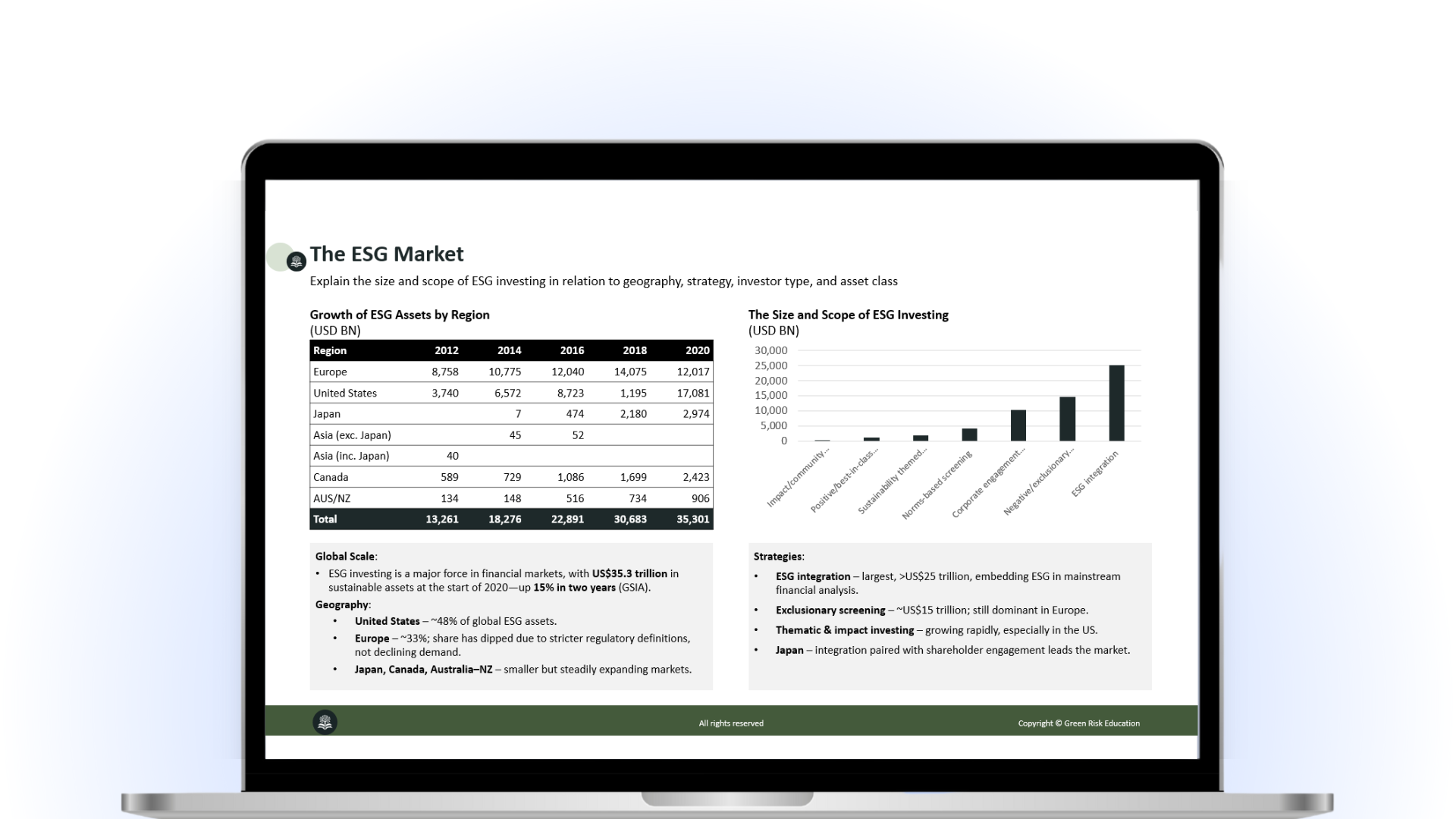
CFA ESG / Sustainable Investing Course:
-
10+ hours of video lectures aligned to every learning objective.
-
Full summary notes split by learning objectives (100+ pages)
-
450+ chapter‑style questions and 4–5 full length mock exams.
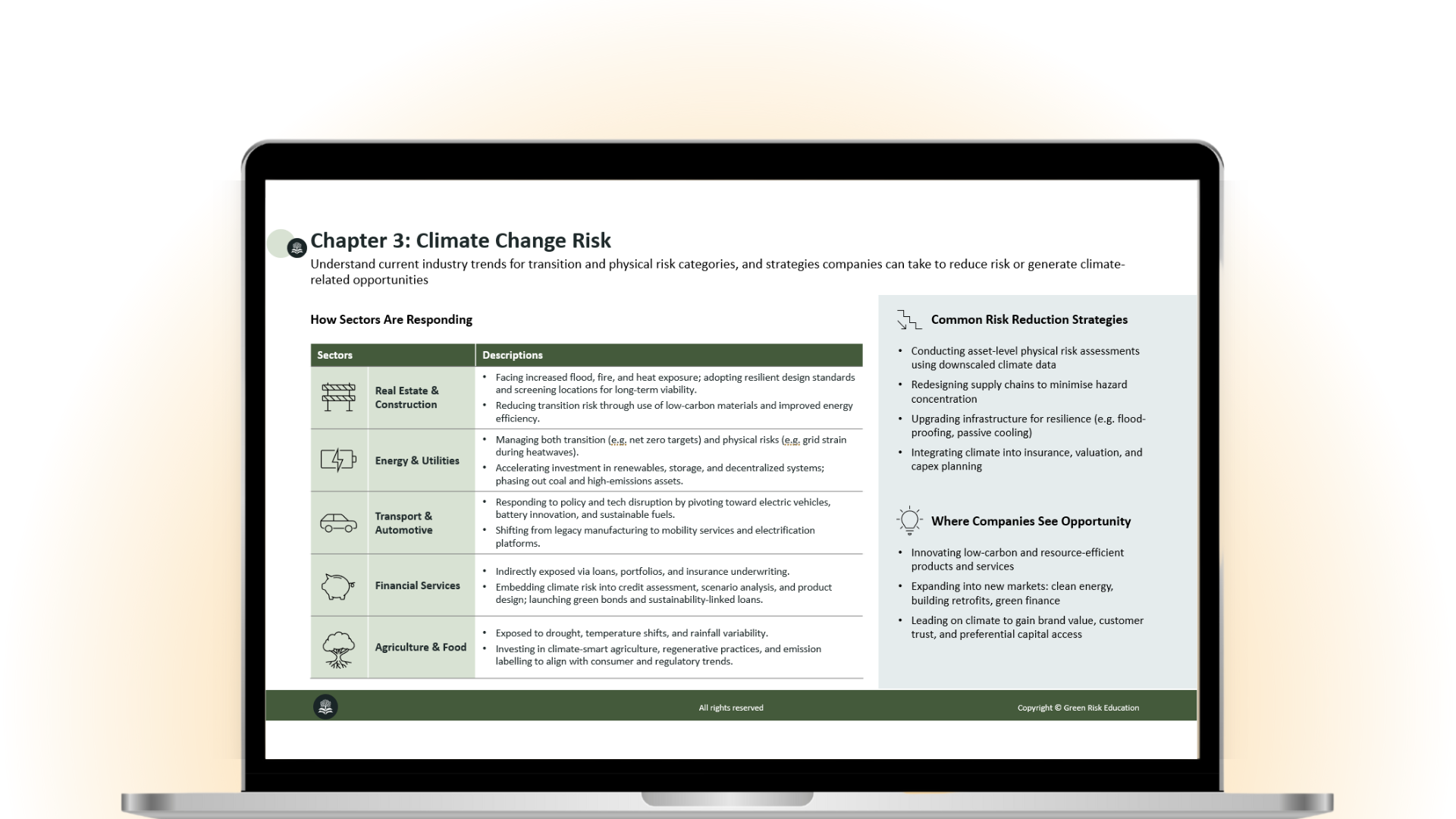

We are an online educational platform that helps professionals and aspiring individuals prepare for sustainability exams
Copyright © Green Risk Education 2026
Copyright © Green Risk Education 2026
Popular courses
Created with