CFA ESG vs GARP SCR - Which Sustainable Finance Cert Should You Take?
CFA ESG (Sustainable Investing) vs GARP SCR comparison: exam format, study time, difficulty, career fit, and which sustainable finance cert matches your role.
Feb 27
/
Green Risk Education
The Short Answer Up Front
Portfolio managers and analysts
Choose CFA ESG/Sustainable Investing because it teaches you how to screen ESG factors into portfolios, adjust valuations for sustainability risks, and build client-ready ESG strategies.
Risk managers and ERM professionals
Choose GARP SCR because it gives you the climate risk measurement tools, scenario analysis frameworks, and TCFD reporting skills that regulators and CROs expect.
Hybrid ESG-risk roles
Start with your current job focus, add the second cert later because you'll speak both portfolio language (CFA ESG) and risk quantification language (GARP SCR), making you indispensable for climate/ESG transition teams.
It is important to note that besides CFA ESG and GARP, there are other options which include:
CFA Institute’s Climate Risk, Valuation, and Investing Certificate
PRI Academy ESG Certificates
SASB, GRI, TCFD‑related training
For the purpose of this post, we will keep the main comparison table to CFA ESG / Sustainable Investing vs GARP SCR, then briefly position the others at the end.
CFA ESG vs GARP SCR Comparison Table
CFA Sustainable Investing Certificate
GARP SCR
Best for
Portfolio managers, equity analysts, wealth managers, investment professionals who integrate ESG into portfolios.
Risk managers, credit risk, ERM, climate‑risk analysts, and professionals who quantify and manage climate‑related financial risk.
Core focus
ESG analysis, ESG integration into valuation, portfolio construction, product design, and ESG reporting.
Climate science basics, climate risk measurement, scenario analysis, regulation, green finance, and risk‑management frameworks.
Exam format
1 computer‑based exam, ~100+ questions, scenario‑style and case‑study questions.
1 computer‑based exam, 100 questions, 2 hours, heavy on scenario‑based and quantitative risk questions.
Study time
CFA suggests around 100–130 hours of study per candidate.
GARP also suggests around 100–130 hours of study.
Pass mark
Roughly 60–70% minimum, depending on form.
Pass mark not published, but typically around 60–70% based on external prep providers.
Average pass rate
~70%
~50-60%
Style of questions
Many case‑style questions, e.g., “How would you integrate ESG into this portfolio?” or “Which ESG risk would you prioritise?”
Many climate‑risk and scenario‑based questions, e.g., “Which metric best captures transition risk for this sector?
Do you need both CFA ESG and GARP SCR
If you're in a hybrid role like an ESG-focused risk manager, ESG-risk analyst on a trading desk, or climate-risk portfolio manager, you can consider pursuing both certification. These positions require you to speak both "portfolio-level ESG" language and "risk-measurement" language fluently.
The combination also builds broad sustainable-finance credibility. CFA ESG signals you understand ESG integration in investing, while GARP SCR shows you grasp how climate risk impacts balance sheets and capital requirements.
Together, they prove you can handle both the investment side and the risk quantification side of sustainable finance.
What about other certifications?
Other sustainable finance certifications exist, but most are niche or too general for technical investment/risk roles.
Key takeaways:
CFA Climate Risk Certificate: Skip if you've already done CFA ESG (it's a deeper climate-valuation add-on, not a beginner cert).
PRI ESG Certificates: Too principles-based and soft for portfolio managers or risk professionals who need hard skills.
SASB/GRI/TCFD training: Only relevant for pure ESG reporting or corporate sustainability jobs, not investing or risk management.
Our recommendation is to stick with CFA ESG or GARP SCR unless your role is reporting-focused. These two deliver the most career impact for finance professionals.
How Green Risk Education fits in
At Green Risk Education, we design courses that map directly to these exams:
CFA ESG / Sustainable Investing Course:
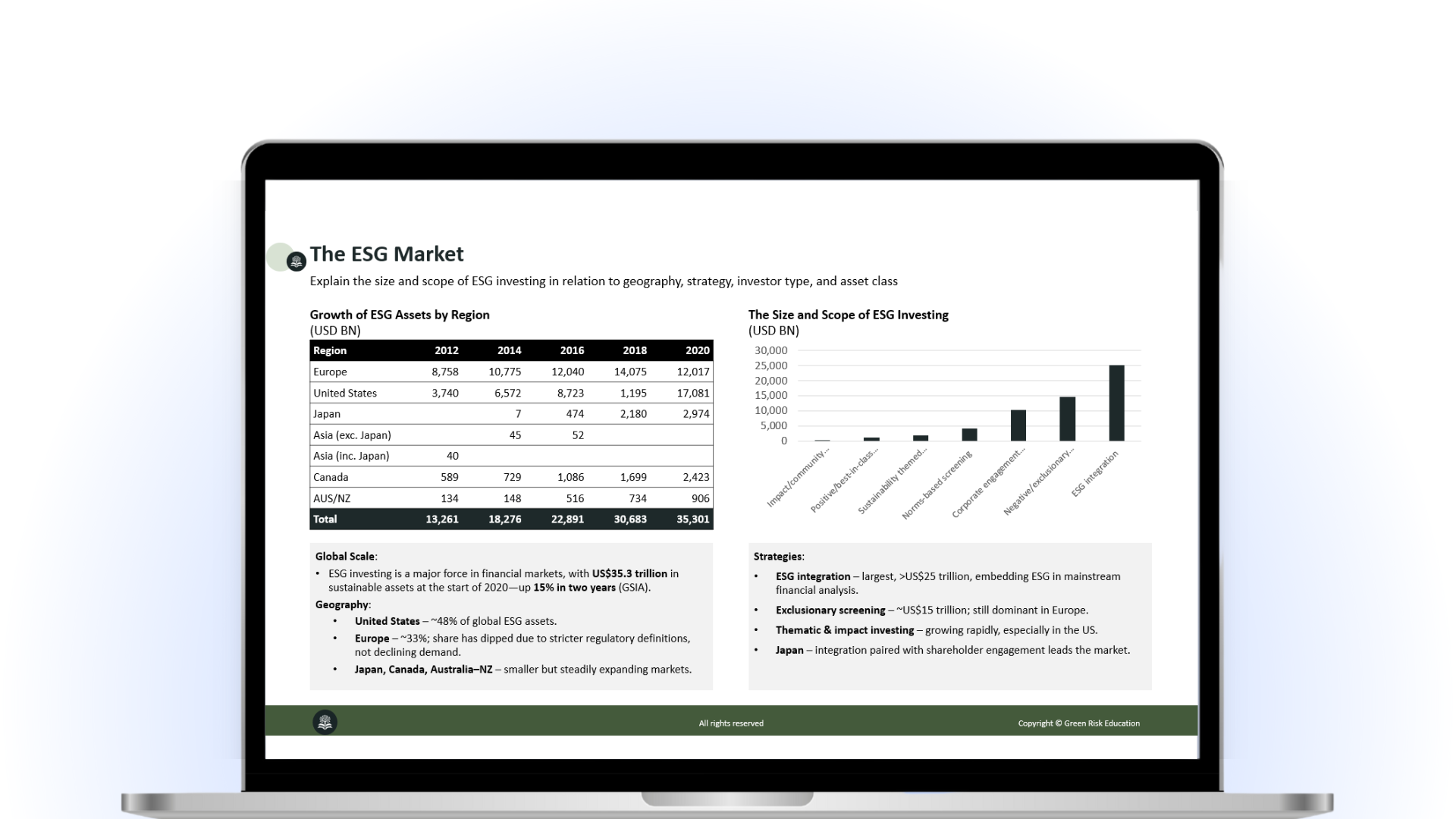
10+ hours of video lectures aligned to every learning objective.
Full summary notes split by learning objectives (100+ pages)
450+ chapter‑style questions and 4–5 full length mock exams.
GARP SCR Course:
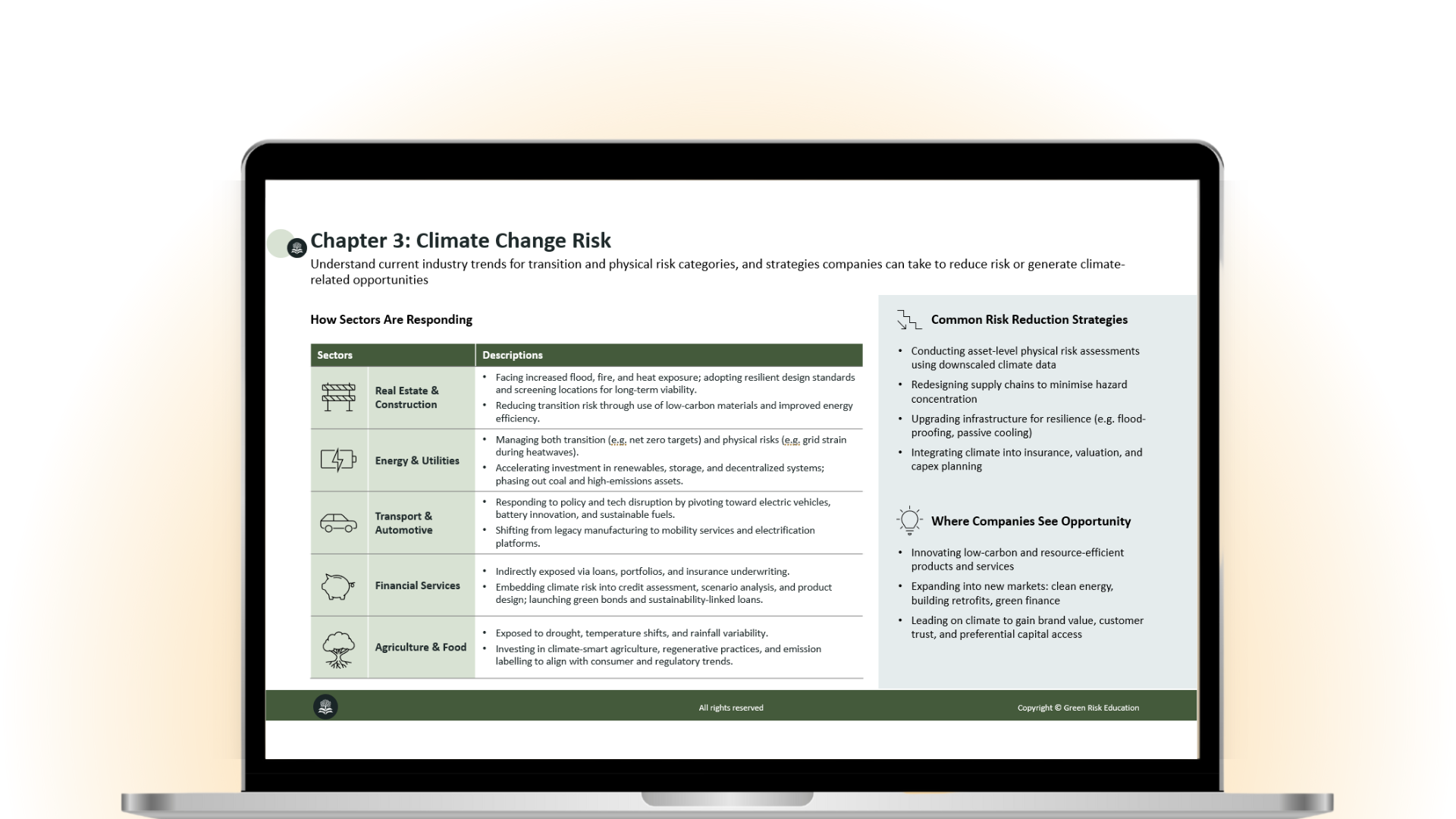
10+ hours of video lectures aligned to every learning objective.
Full summary notes split by learning objectives (100+ pages)
450+ chapter‑style questions and 4–5 full length mock exams.
40% OFF!
FLASH SALE FOR OCTOBER 2026
Get full course access for just $89 (was $149)
Limited to the first 30 students or until the timer ends - whichever comes first.
Code: EARLY2026
Write your awesome label here.
Created with
Login or sign up to start learningLogin to start learning